Category: Uncategorized

  • London May 28-30: Military

    A very brief history of the invasion of Normandy.  The Allied armies made it ashore on five beaches on June 6, and in the next couple of weeks advanced inland a few miles before basically getting stuck in the countryside, blocked by strong German resistance and by the narrow lanes, hills and hedgerows (embankments dividing fields) of the area.  The Allies spent about six weeks grinding through these obstacles, and then suddenly broke through the weakening German defenses at the end of the July.  The Germans were doomed by the fact that all potential reserves had been sent to the Eastern Front and by Hitler’s orders requiring impossible counterattacks or barring retreat.  When the Allies did break through they liberated most of France, including Paris on August 24.  The fourth map in this article dramatically illustrates these events.

    https://www.vox.com/2014/6/6/5786508/d-day-in-five-maps

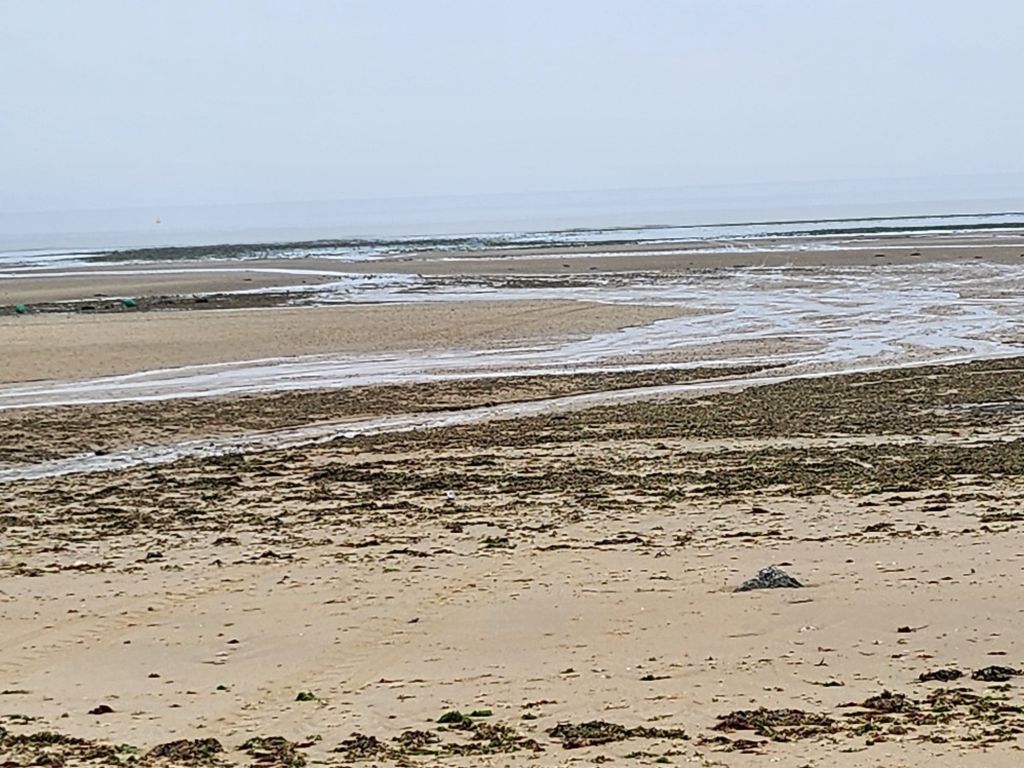
    One more thing about the tides – in Normandy the difference between high and low tide can be 200 or 300 yards more of beach.  Here’s a picture of one of the British beaches at very low tide.  Fortunately the Germans barely defended the beach so the extra distance didn’t matter.
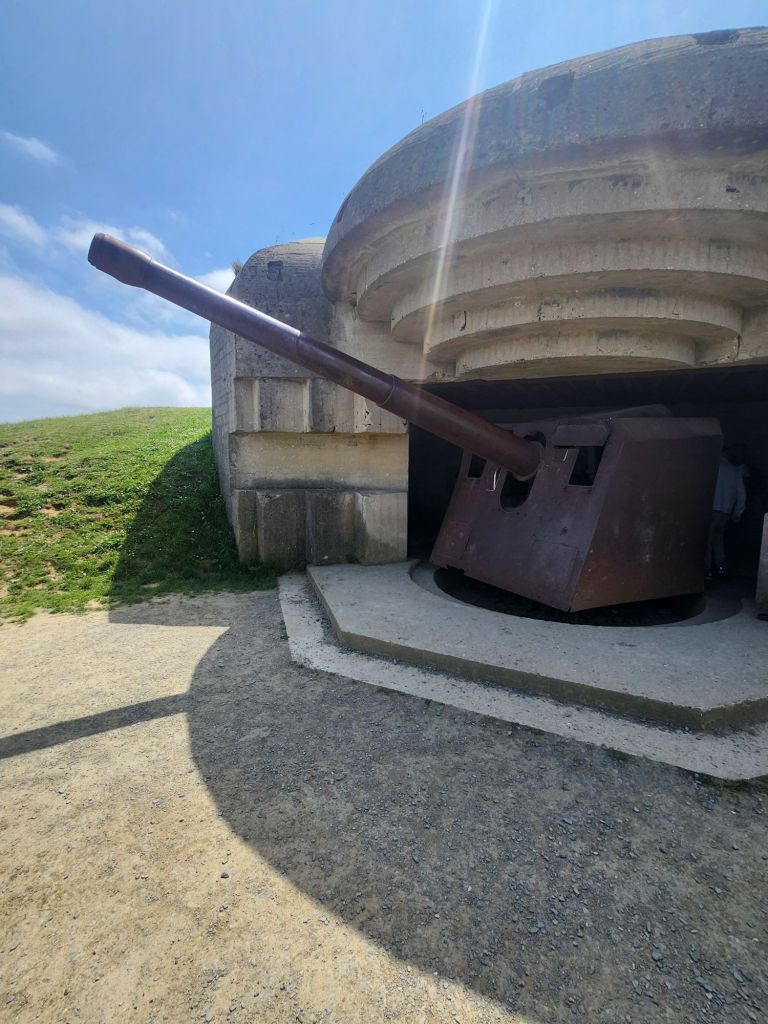
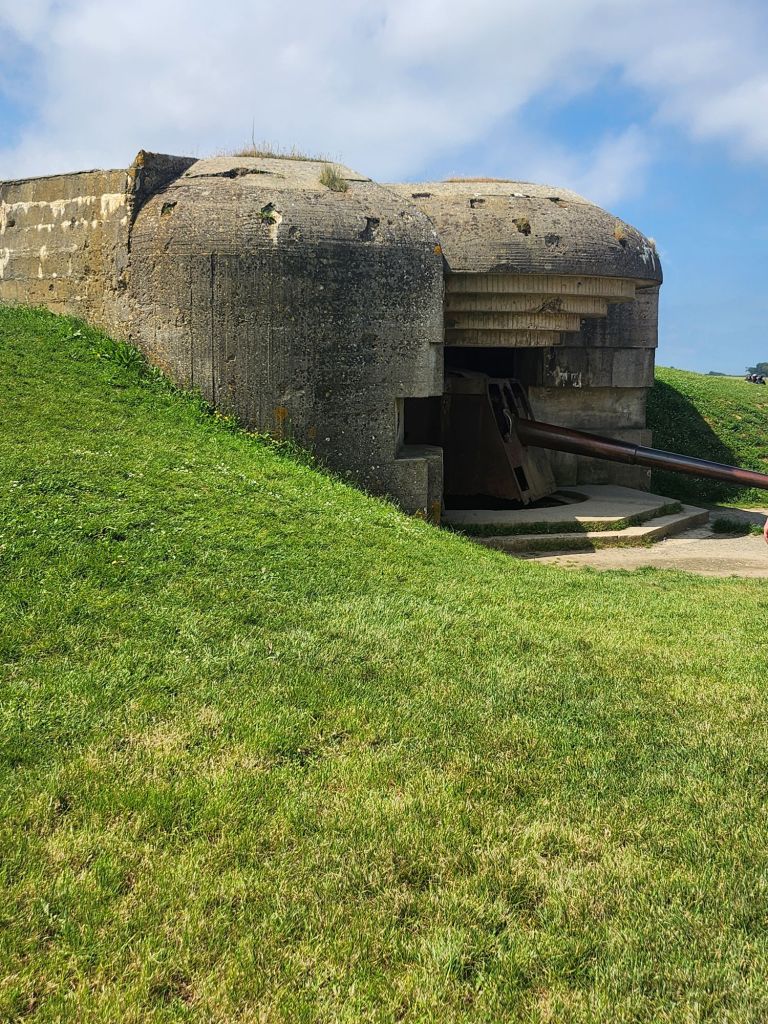
    We visited several sites important to the British part of the invasion. At Longres Sur Mer the Germans had four large pieces of artillery that could fire right onto the landing beaches.   The Allies heavily bombarded them by plane ship before and on D-Day.  The Allied ships hit a couple of the guns, stunned the crews of the other two, and cut the telephone lines running from the observation post overlooking the beaches.
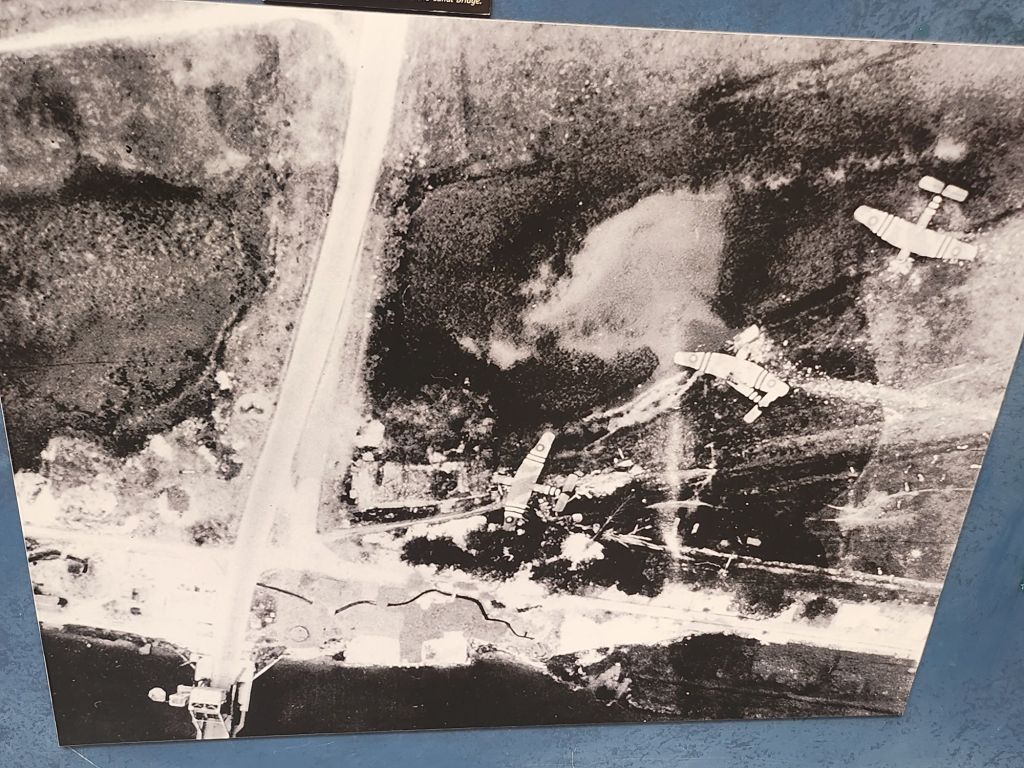
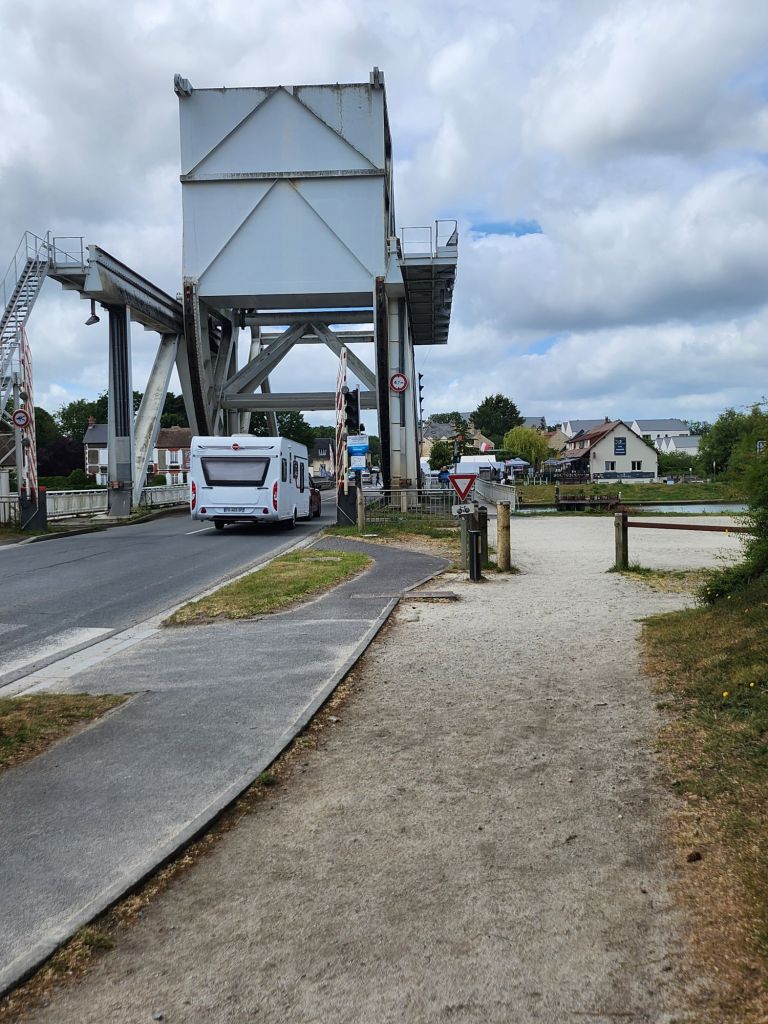
    We went to Pegasus Bridge, the site of a successful D-day glider operation. The bridge was the best way over a canal just a few miles from the British landing at Sword Beach.  By taking it the Brits could stop German reinforcements from coming to the beach and preserve it for the Brits’ own advance.  The Brits planned a glider attack, in which gliders full of troops were towed by cargo planes and released at several thousand feet to glide to their targets.  Even though the general commanding the operation was named Pine-Coffin, they executed it perfectly, landing three gliders just a few hundred feet from the bridge, taking it from the very surprised German guards, and holding it for a day until the troops from the beach came up.

    A wartime photograph showing where the gliders landed; the bridge is at the lower left.
    The bridge.
    We visited the site of a British paratrooper attack aganst a German artillery position at Mierville that could fire down on the landing beach.  This attack was also successful, but with greater loss of life.

    Every museum or site we visit has a gift shop, and every gift shop sells D-Day Monopoly, which seems kind of inappropriate. I looked at a copy to see that Boardwalk was Omaha Beach and Park Place was Pointe Du Hoc, a cliff successfully attacked by American paratroopers. But I also saw that the two cheapest properties (Baltic and Mediterranean in the regular game) were Pegasus Bridge and Mierville.  Our British guide vowed to write an outraged letter to Parker Brothers.

    Bomb crater at Pointe Du Hoc. 
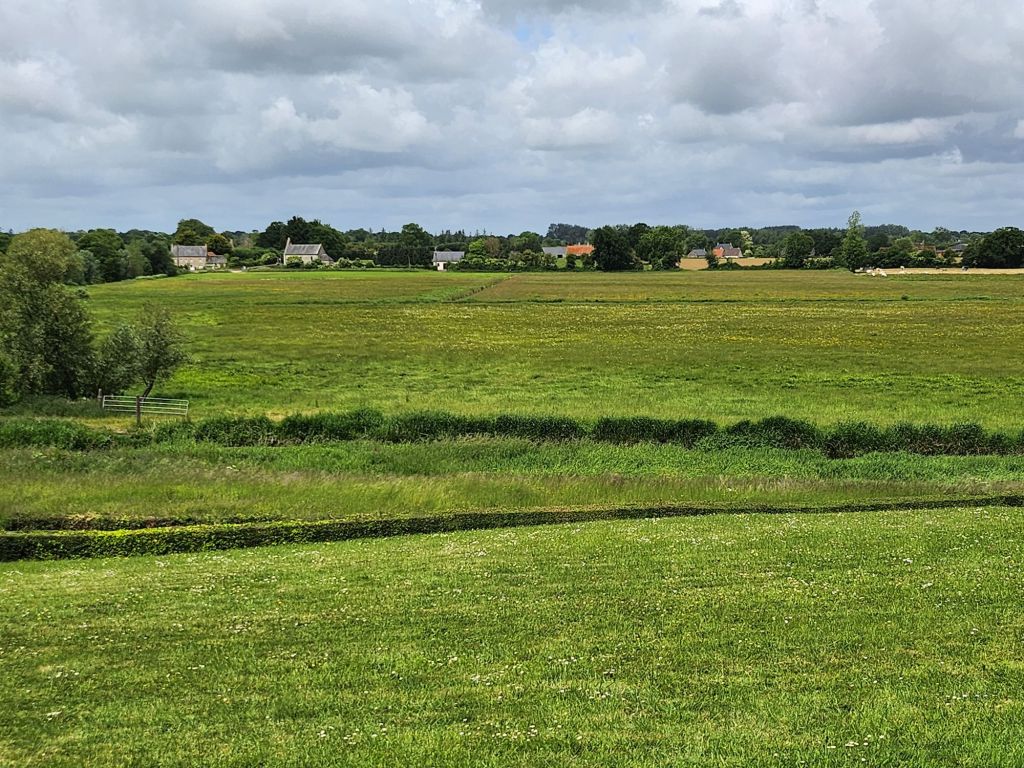
    There were hundreds of these craters in the square mile around the cliff.  There were once tens of thousands such craters near the beaches, but they have been filled in the towns, roads and farm fields.
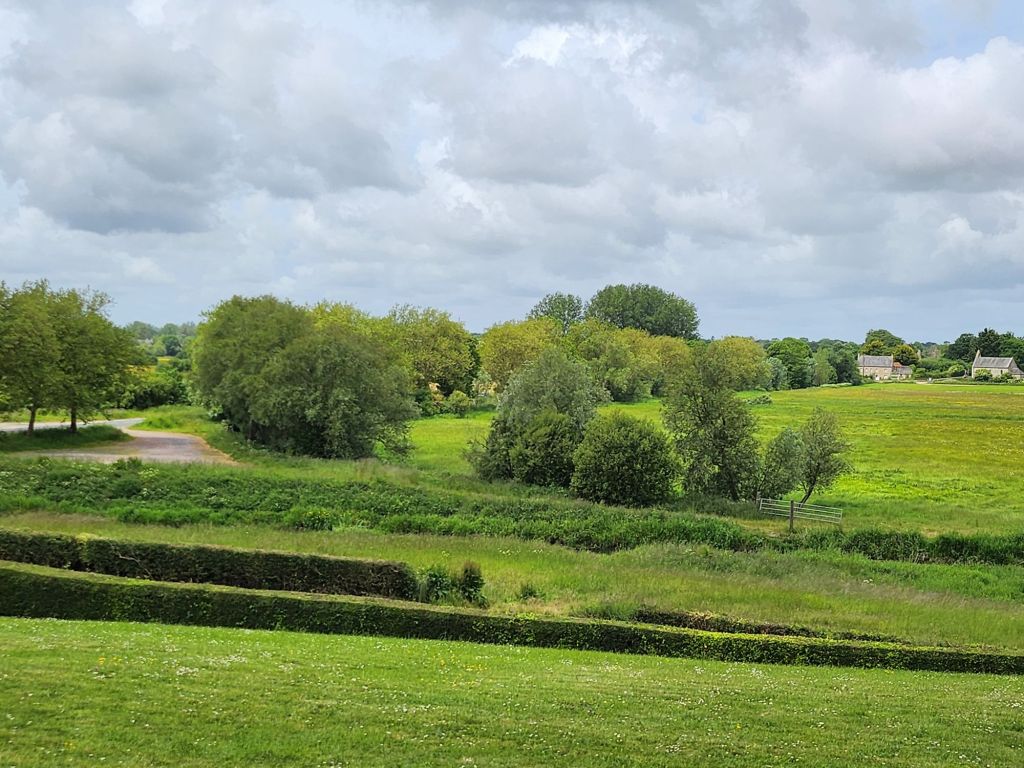
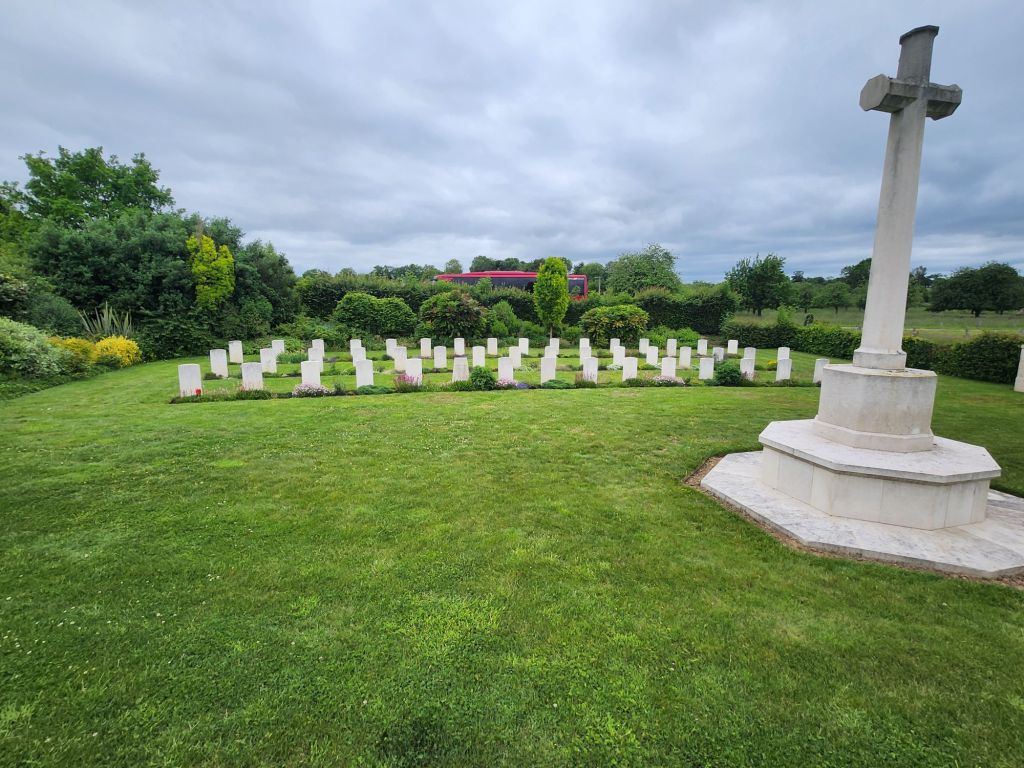
    We visited several British cemeteries.  They were more individualized and intimate than the American one, with flowers and messages on the gravestone from the families.  Our guide said the goal was to recreate the feeling of an English country churchyard.  The most moving was the smallest.
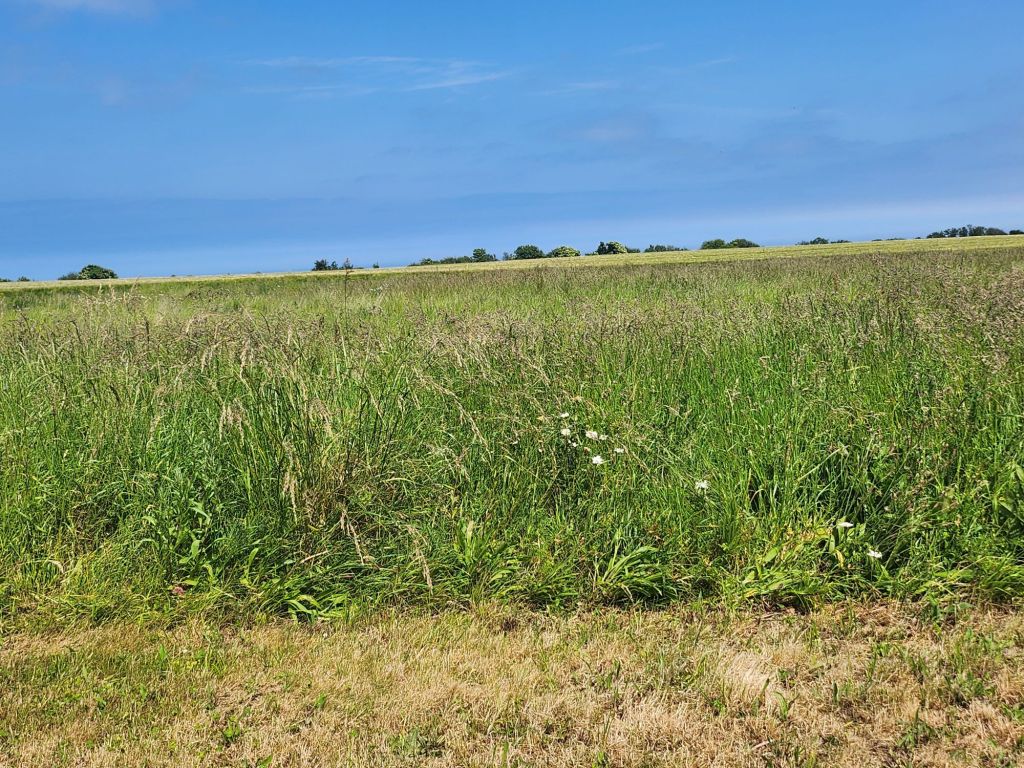
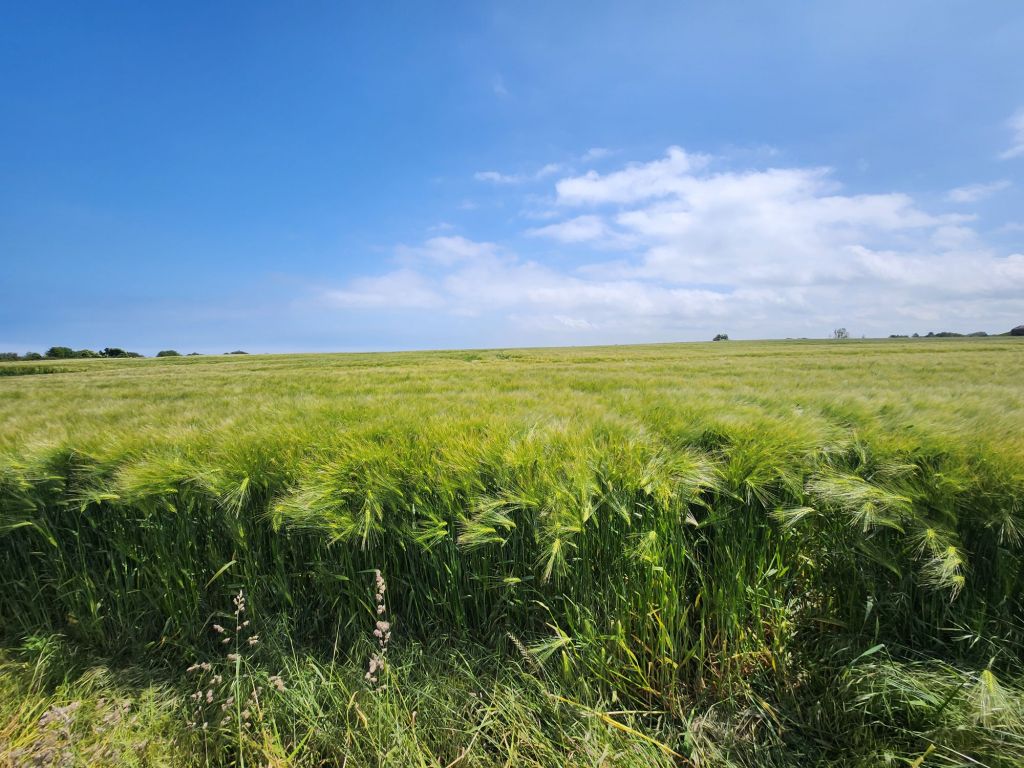
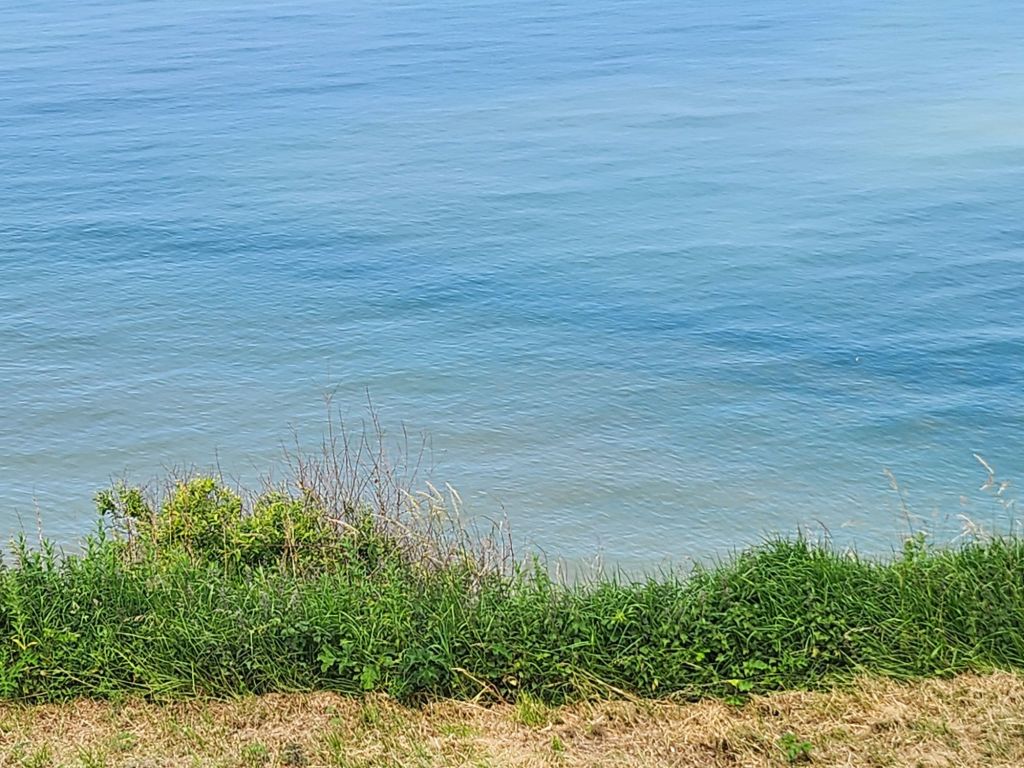
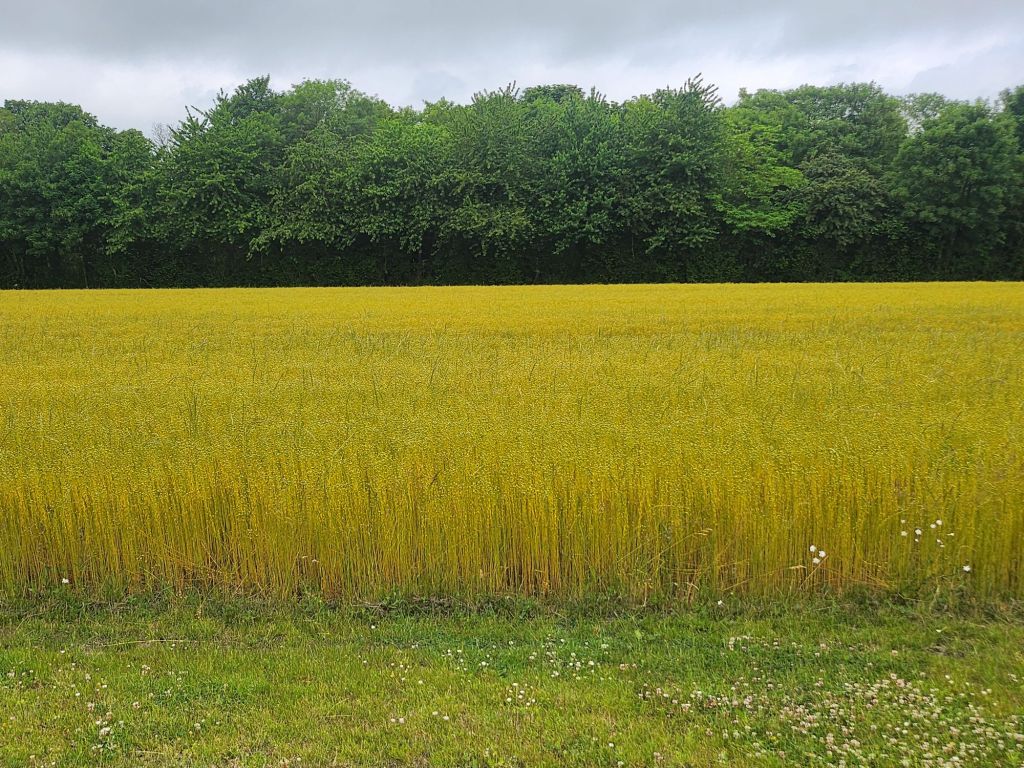
    Too much death and violence.  As we walked around yesterday, I saw a farm field that helped me understand why Impressionism developed in France.  Then I saw several more fields, and one seascape. 
  • May 28-30 — Medieval

    The last three days we have divided our time between the middle ages and 1944.  Apparently not much happened between those periods other than a few references to the French Revolution or Napoleon.  Rather than going day by day I will have one post on each topic.

    William the Bastard, known as William the Conqueror after 1066, was Duke of Normandy starting at age ten (in 1038) after his father died.  Although William was illegitimate he was his father’s only son, so he got the job.  He spent the first ten years of his reign dodging assassination and kidnapping attempts, which apparently toughened him.  After age 20 or so he turned to seeking revenge on those who were against him, which he did by promising to redistribute their lands to his followers.  Supposedly one reason he invaded England was because he ran out of land in Normandy to keep his promises.

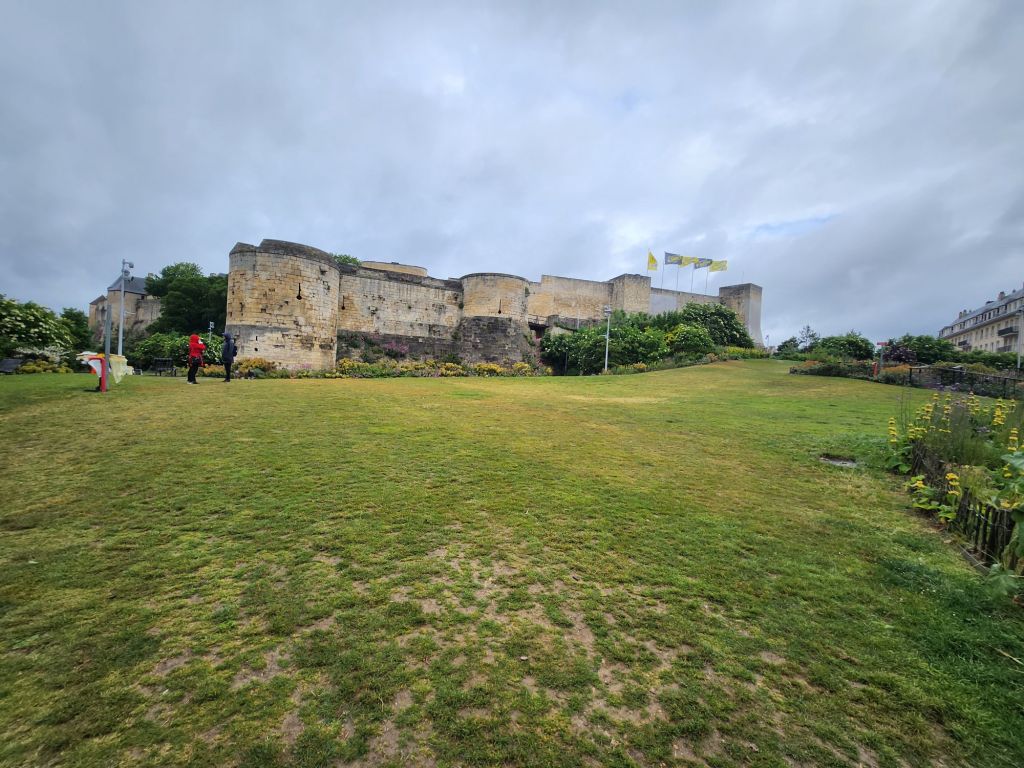
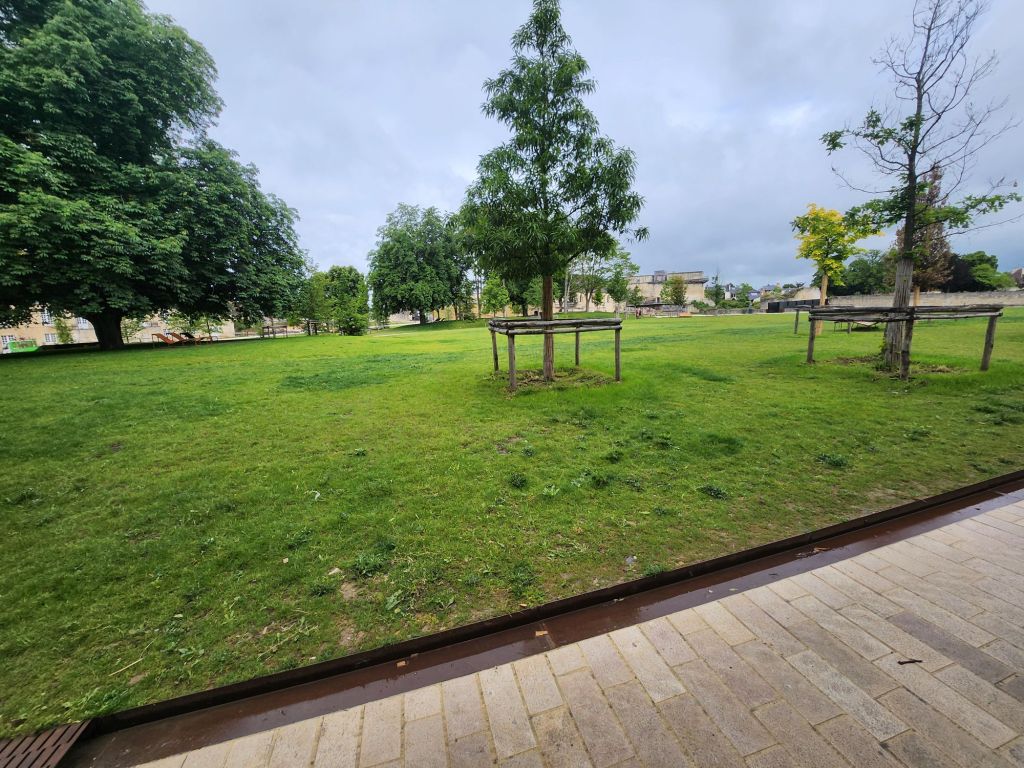
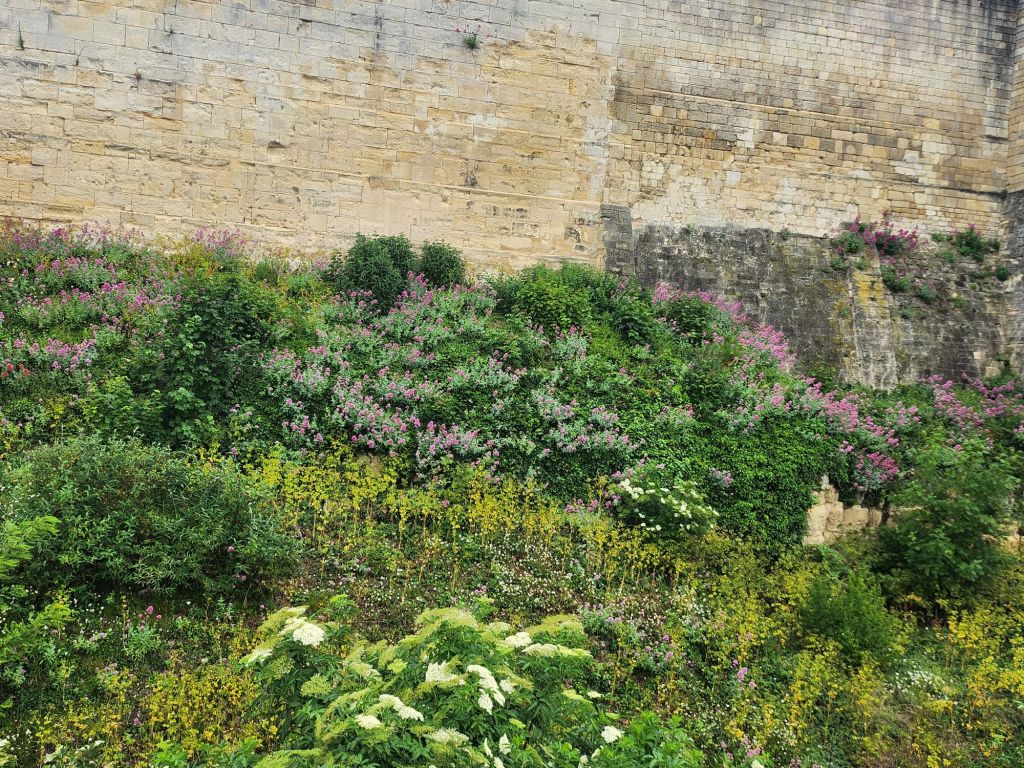
    He and his wife Matilda built a lot of castles and churches in Normandy, particularly here in his headquarters of Caen. First we visited the Chateau in Caen, a third of a mile from our hotel, which was imposing on the outside but  park-like on the inside.
    The ditch (not a moat because it never held water).
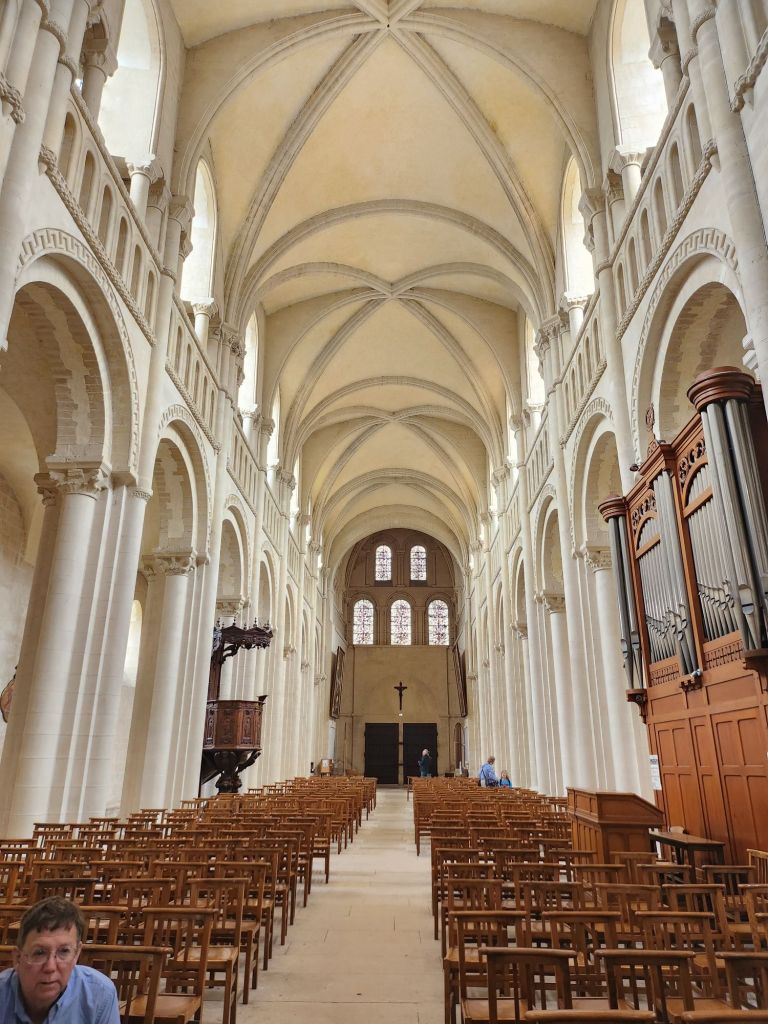
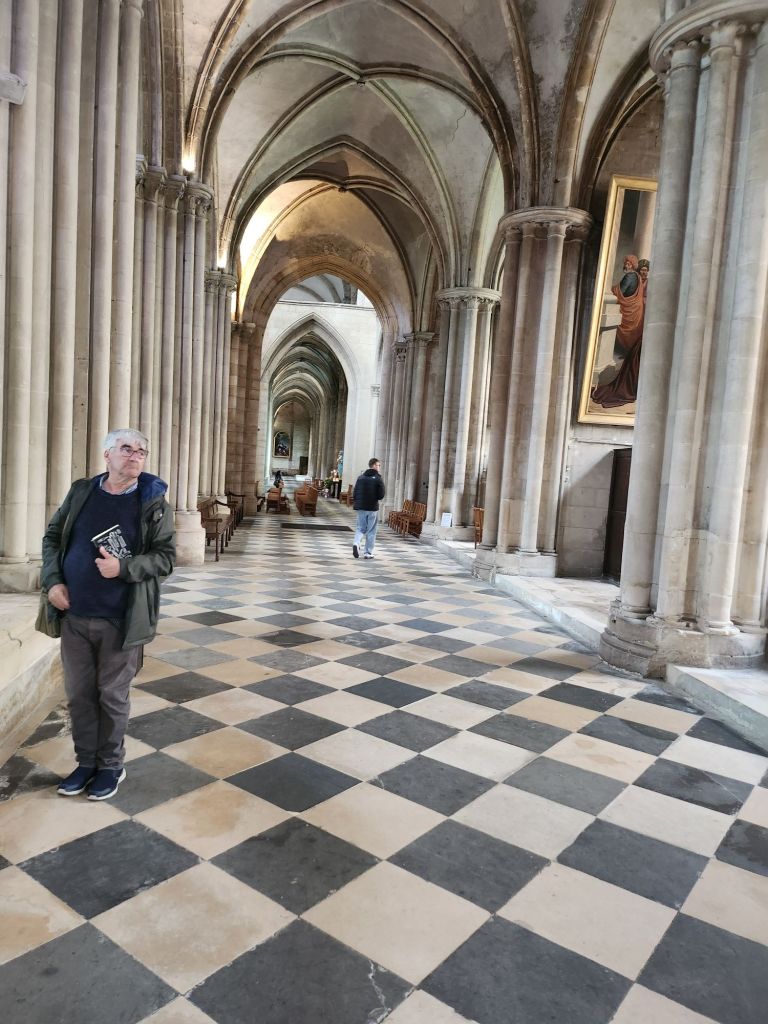
    The nunnery built by Matilda.

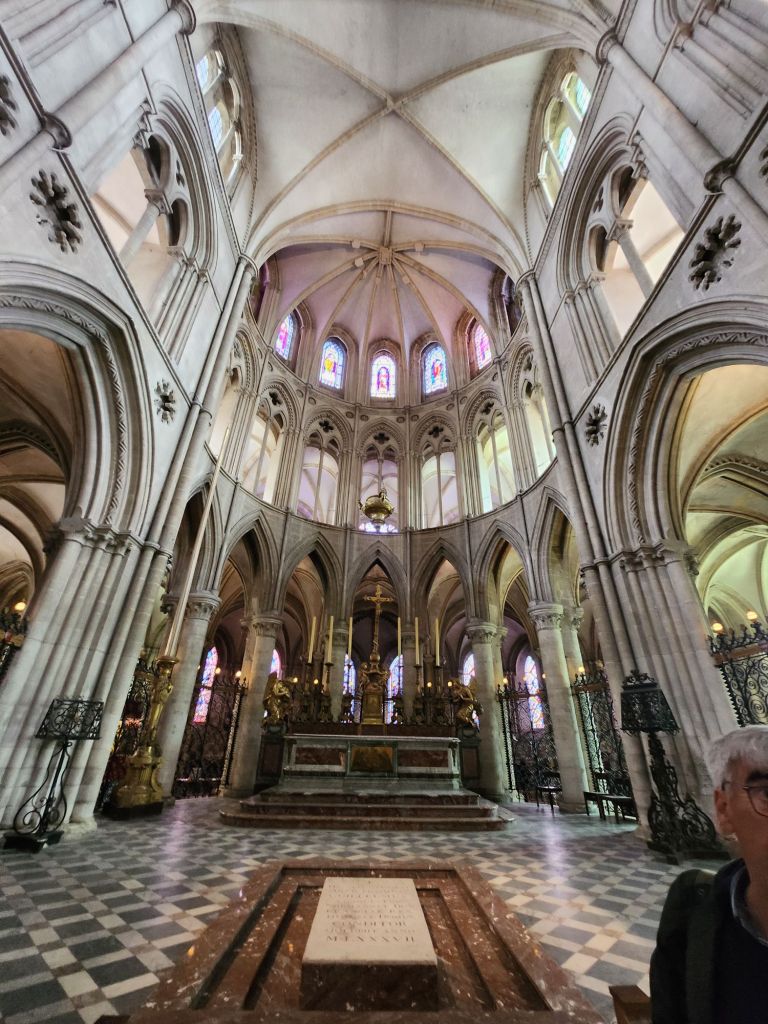
    The monastery that William built, and in which he was buried.  Someone in our group said that in contrast to Matilda’s church his was a good example of manspreading.  Our guide Julian is in the first two pictures.

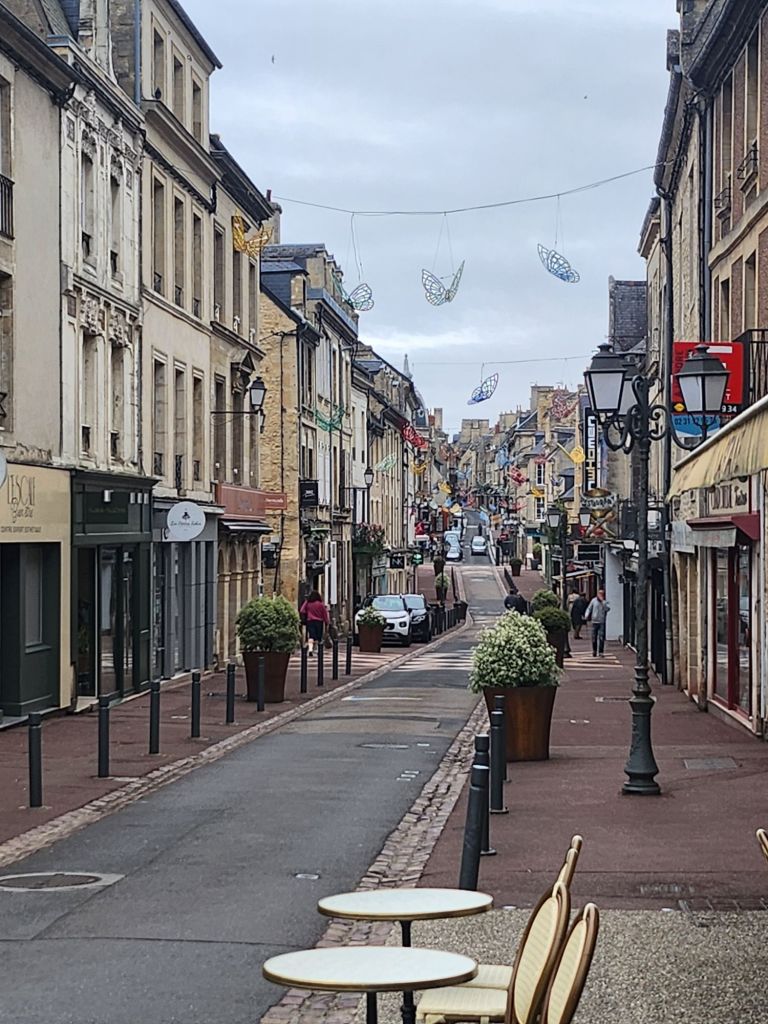
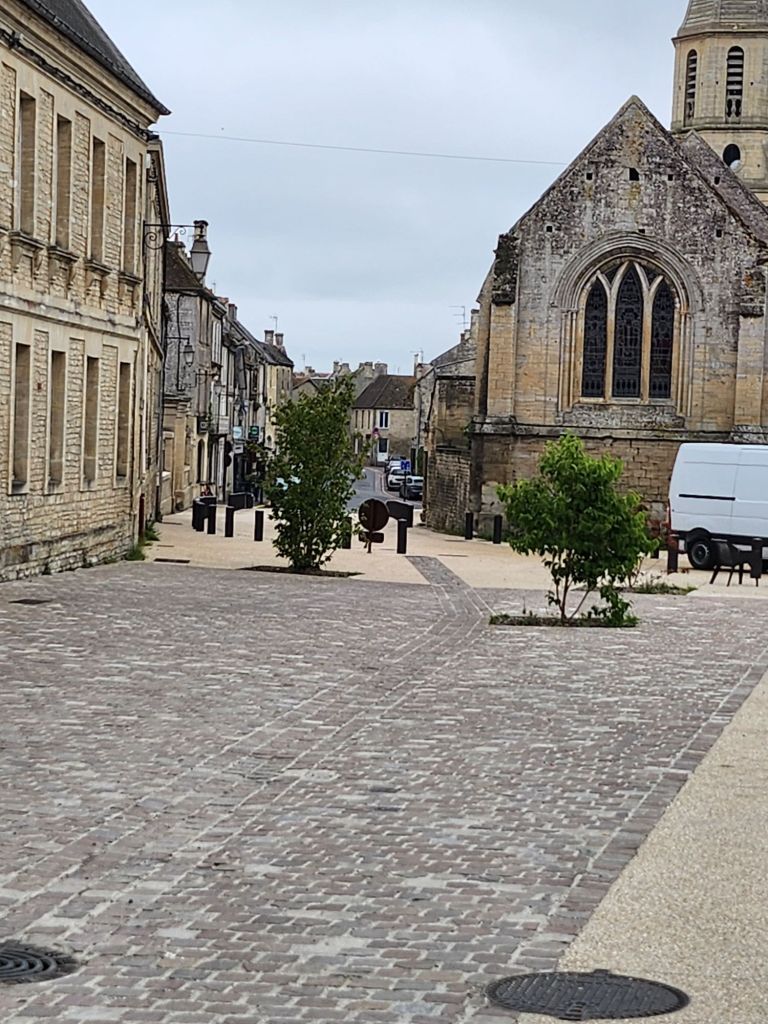
    We visited Bayeux.  Unlike most other towns in Normandy, Bayeux was untouched by WWII.  The central area is pretty large and is filled with narrow streets and medieval buildings, many of them remodeled or rebuilt in the following centuries so that the facades are only three or four hundred years old as opposed to six or nine hundred.

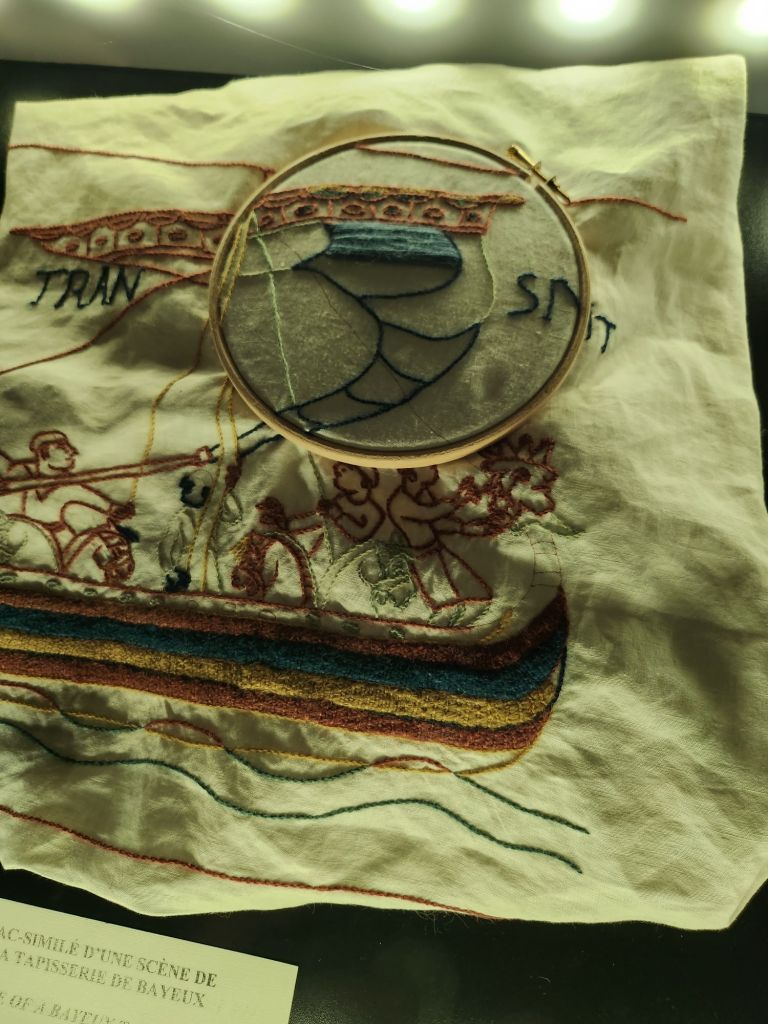
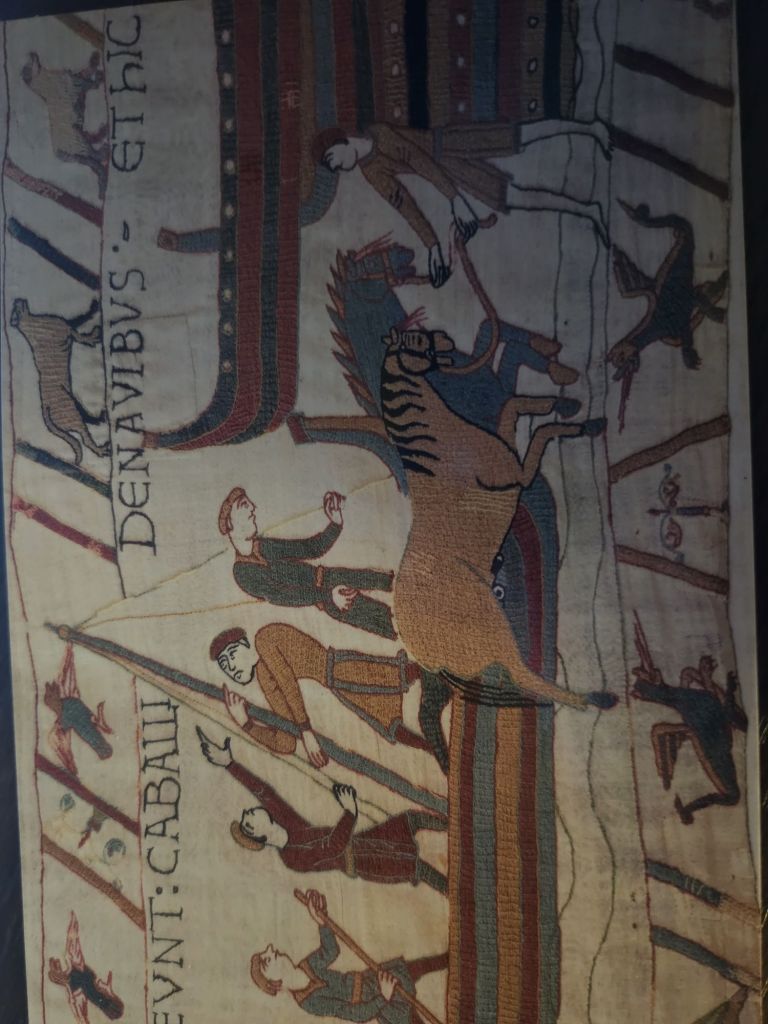
    I had always assumed that the  Bayeux Tapestry was a series of wall hangings depicting the Norman Conquest.  It is about the Conquest, but it’s a continuous scroll about 20 inches high, 224 feet long.  Julian said it is actually embroidered, not woven, and was done in Canterbury, so it should be called the Canterbury Embroidery.  A closeup of a reproduction of the embroidery.

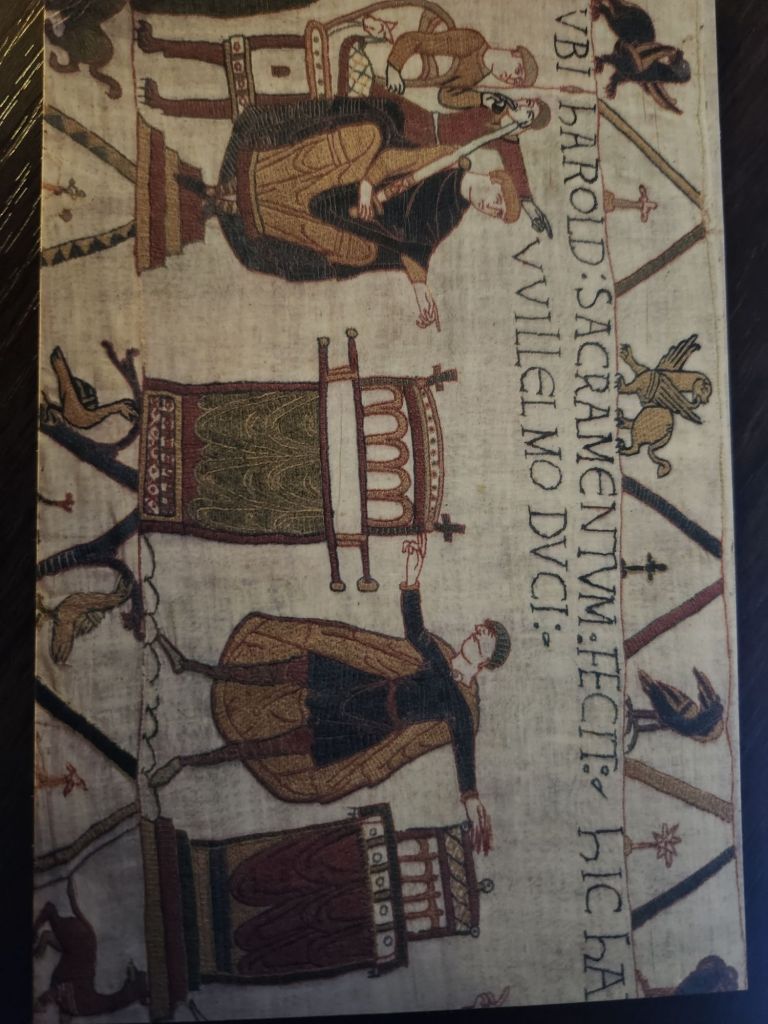
    The Tapestry shows 58 scenes of the diplomatic and military lead up to the invasion.  The central propaganda claim is that the childless king of England, Edward the Confessor, promised the throne to William and that a rival claimant, Harold, first acknowledged William’s right and then seized the crown for himself.   So basically William had to invade.  The Tapestry shows scenes as important as Harold swearing allegiance to William (on two boxes of relics because William didn’t trust him)

    or has routine as soldiers cooking stew

    Also lots of horses – getting on and off ships, charging, fleeing, delivering messages.


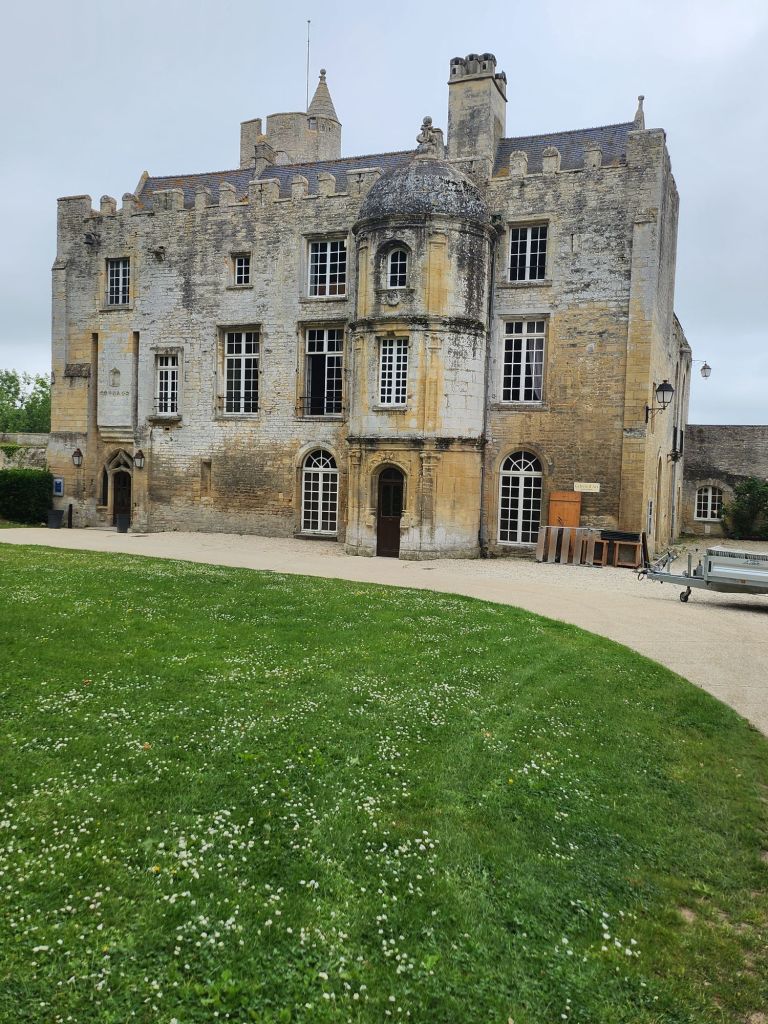
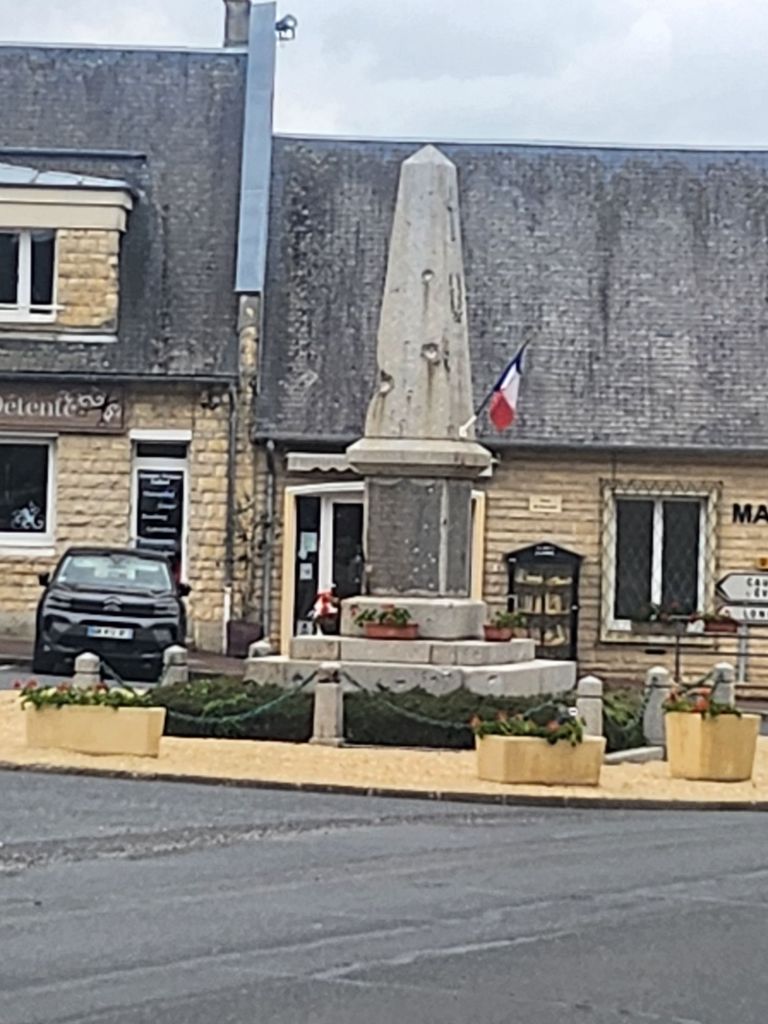
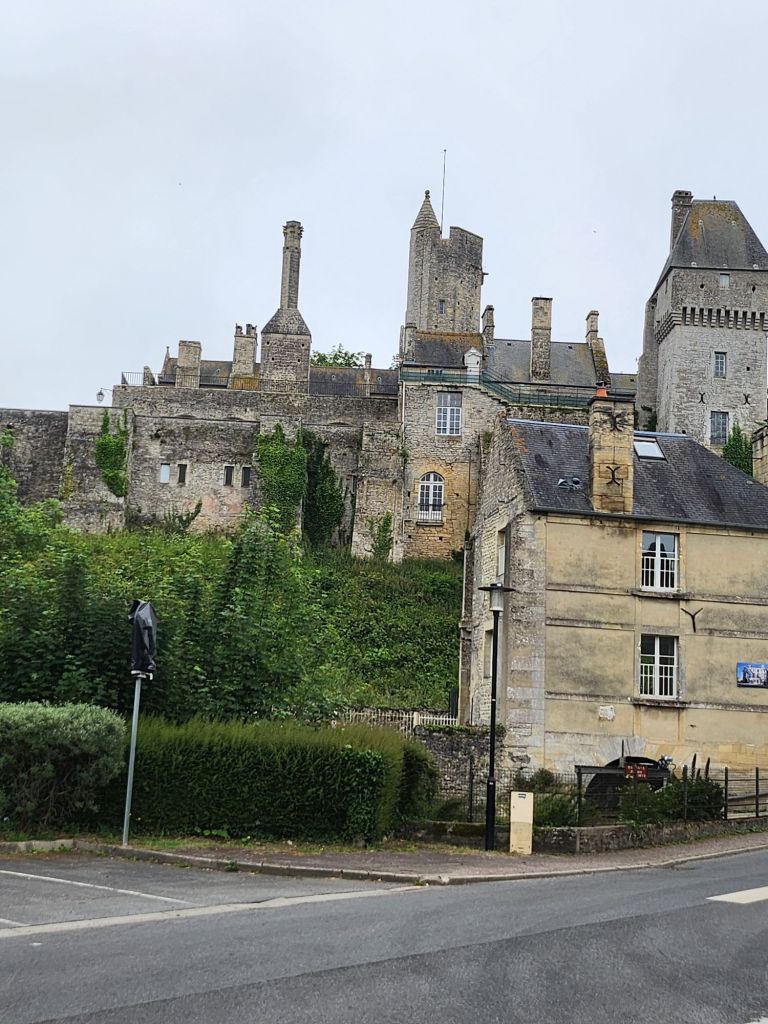
    Also some beautiful  medieval places that I don’t have any descriptions for:

  • Mont-Saint-Michel May 27

    A couple of additions to the post about WWII sites.

    First, in response to questions:  Plywood landing craft (as opposed to something bulletproof) would have been much faster (meaning less time exposed to fire), cheaper, and able to use a smaller engine.  And the craft would probably only be used once.   I think the  decision was basically borne out — there were no real problems on four of the five landing beaches, and on Omaha Beach almost all the casualties happened after the soldiers were out of the craft.  The landing  was deliberately at tide because the Germans set up a lot of obstacles at the tide line that the planners wanted the craft to avoid.  There were about 18,000 paratroopers and glider troops on D-Day.  I have an entry coming up on a remarkably successful British glider operation.

    Also, in the paratrooper museum they had a section on life in occupied France, which included copies of French-language German propaganda magazines that attempted to persuade the French to accept their lot as an occupied people. The magazines were surprisingly glossy and, except for some gross Jewish caricatures, surprisingly subtle.  One had an illustration of French farmer addressing a shower of British bombs being unleashed by a Churchill in the clouds, the farmer saying “Just leave us alone!”  There was another article about the good fortune of a French family that had the father working in Germany; the illustration showed the happy father, the happy family and the money flowing  between the two. 

    Our British tour guide many times pronounced Utah (as in Utah Beach) as “oo-tah” despite repeated reminders that it is “you-tah.”  He had heard my favorite piece of US Army slang, used by combat troops about anyone who was not in the line of fire:  REMF, for “rear echelon motherfuckers.”

    Ok, turning the clock back to the 11th century. That’s when construction started on Mont-Saint-Michel, which never seemed real to me in pictures. 

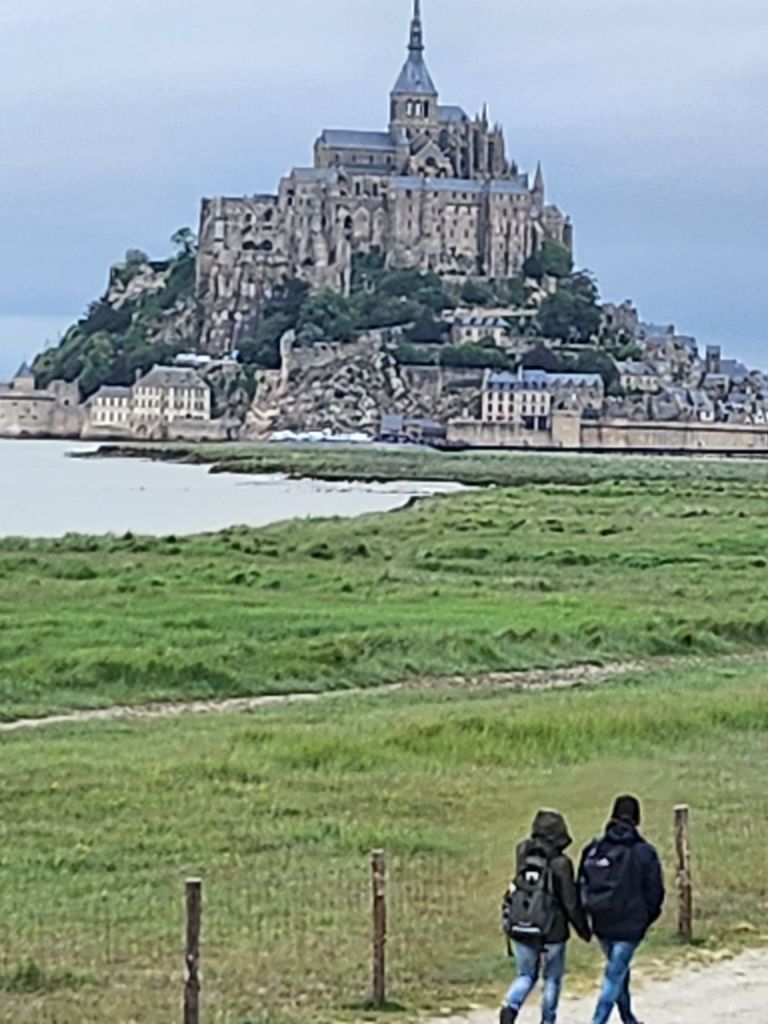
    It also did not look quite real in the walk from the parking lot to the causeway across the mud- and tidal flats to the area.  The causeway was built ten years ago; in the preceding decades there was a parking lot very near the base (now a green area) which our guide said really detracted from the magic.

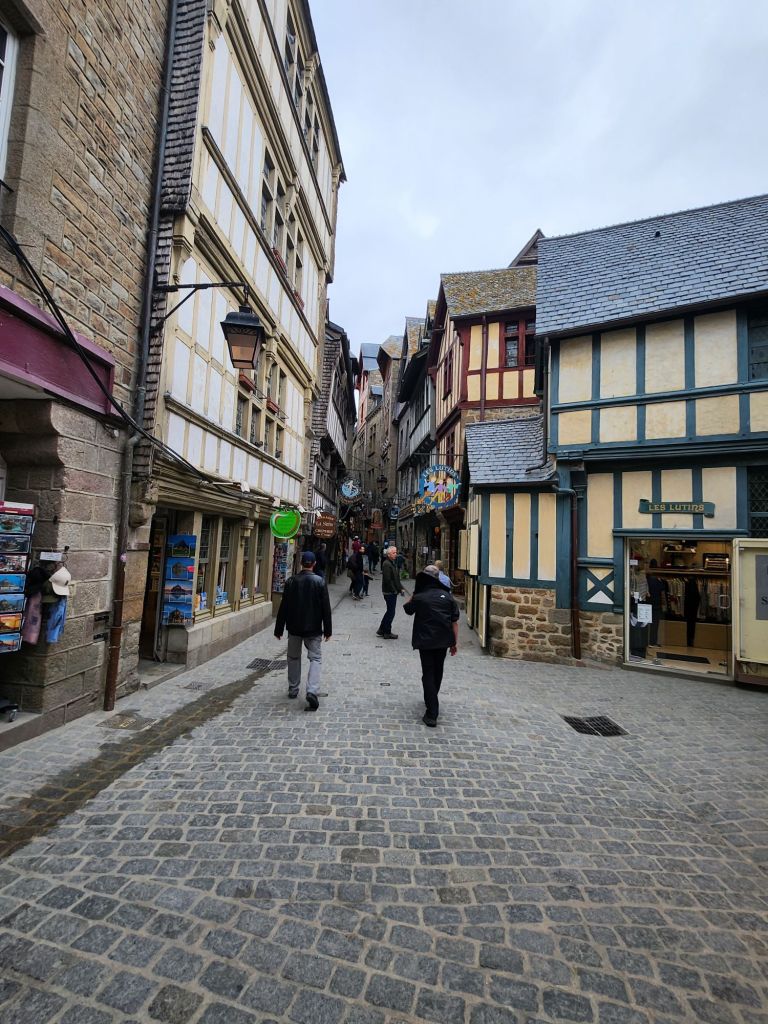
    It does seem a little more real when you start up the steep narrow main street, which would have been charming if you took away the souvenir shops.  There was no orientation or history or visitor center before you start climbing.  All this made me appreciate the National Park Service. 

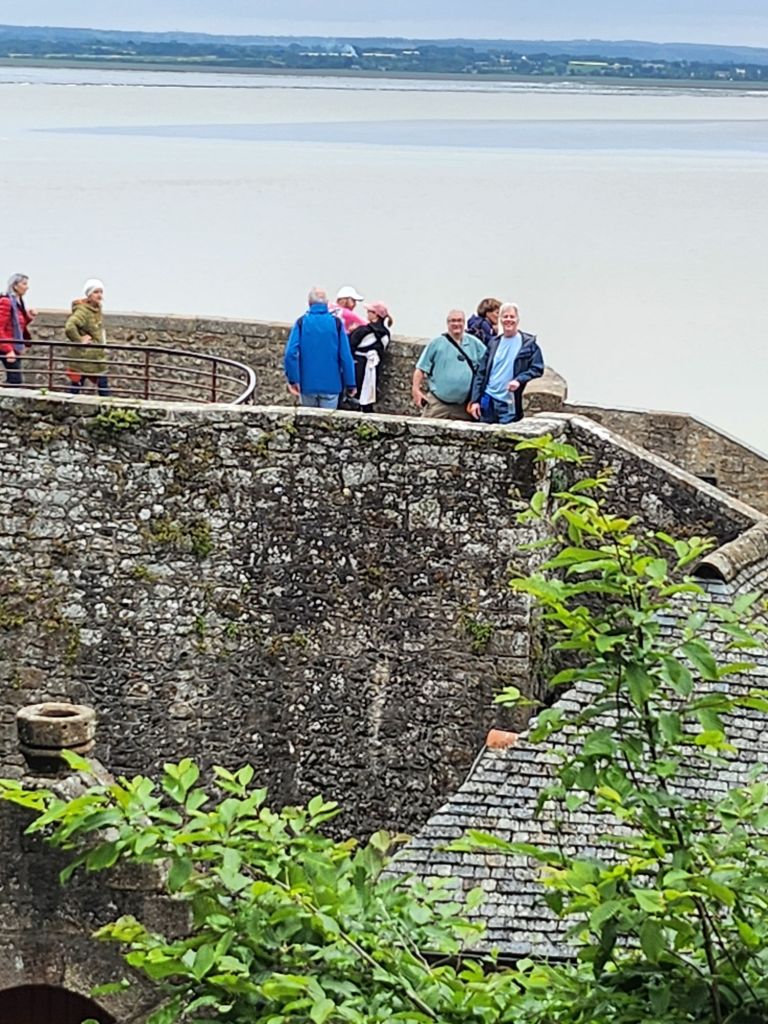
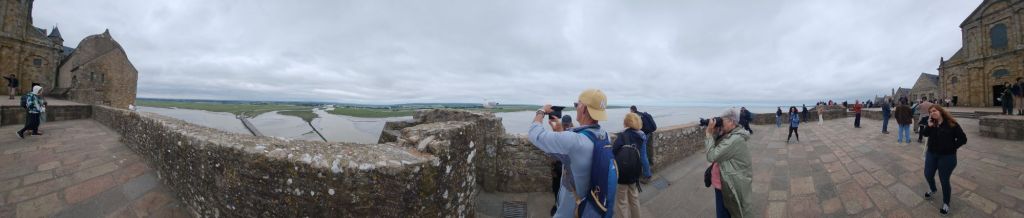
    As you proceed, however, the crowds are thinned by the climb and by the admission fee to the monastery (though the area has not functioned as an active religious site for a few hundred years — well before the French Revolution).  As yesterday, I will mainly let the photos do the communicating.

  • Normandy May 24-26

    Spent most of the time on D-Day sites.  Neither photographs nor words really convey what we saw but photographs are better I think.  Here’s the synopsis:

    May 24 recovery day in Caen, meeting with group.

    May 25 Dday museum, Omaha Beach, American Cemetery

    May 26 Paratroopers Museum, St. Mere Eglese, Utah Beach

    Our guide for the tour, Julian, is knowledgeable, funny, enthusiastic.

    May 25

    Omaha Beach Museum.  Lots of WWII tanks, trucks, jeeps etc. from all armies.  Placards informed about the weight, guns, armor, etc., and — what I liked best — where the vehicle was found — in a garage in Le Mans in 1971, in a junkyard in Bayeux in 1975, being used to haul apples in Normandy in 1960.  Learned that the German tanks were much better than the American ones, but German industry only produced about 10,000 over the course of the war as opposed to 50,000 American. 

    Omaha beach — the bloodiest of the five landing beaches on D-Day — shown at the beginning of Saving Private Ryan. We were there on a cool overcast day somewhat like D-Day itself, with the major difference that the sea was much calmer.

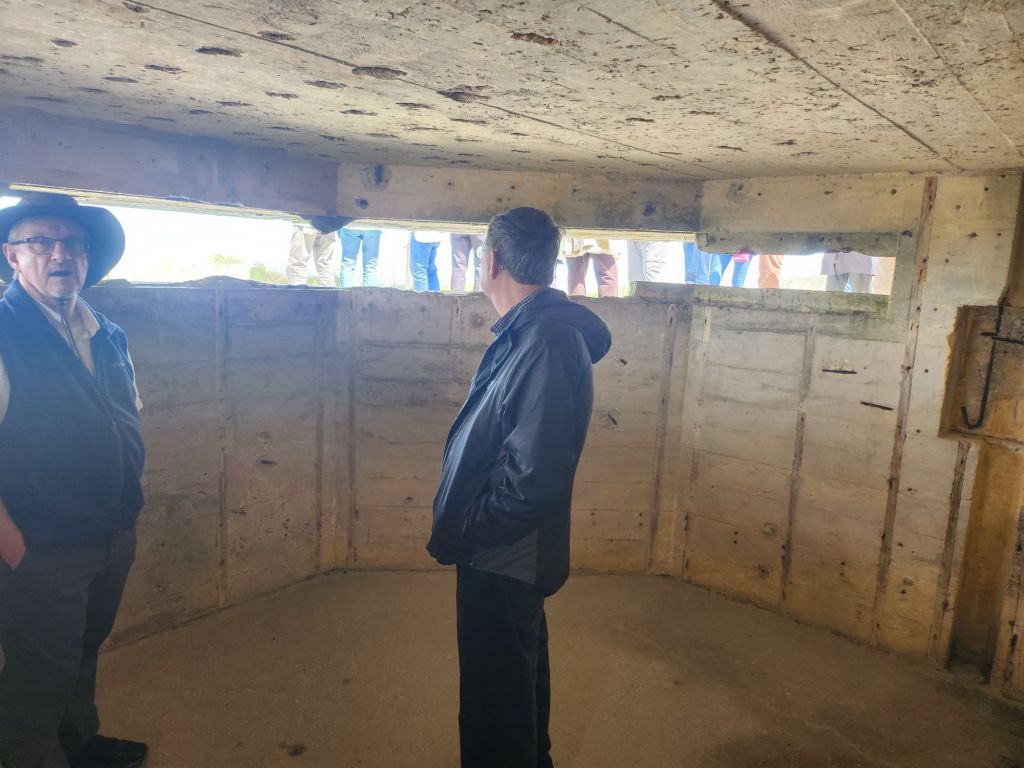
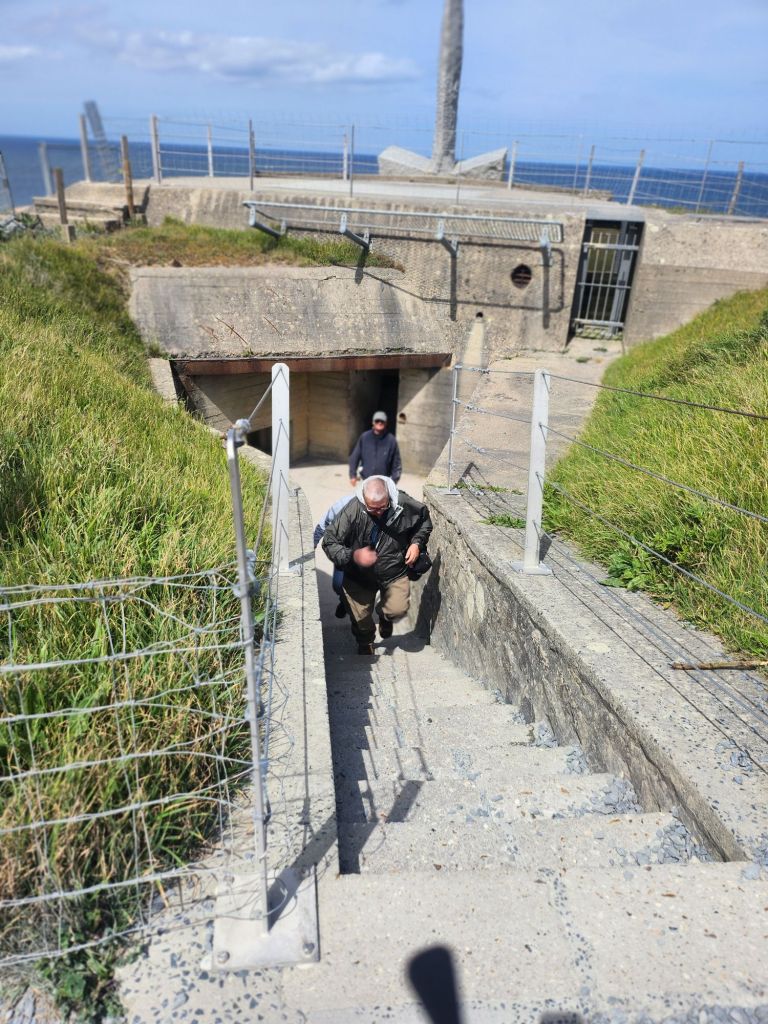
    Inside and outside of a German bunker overlooking the beach.

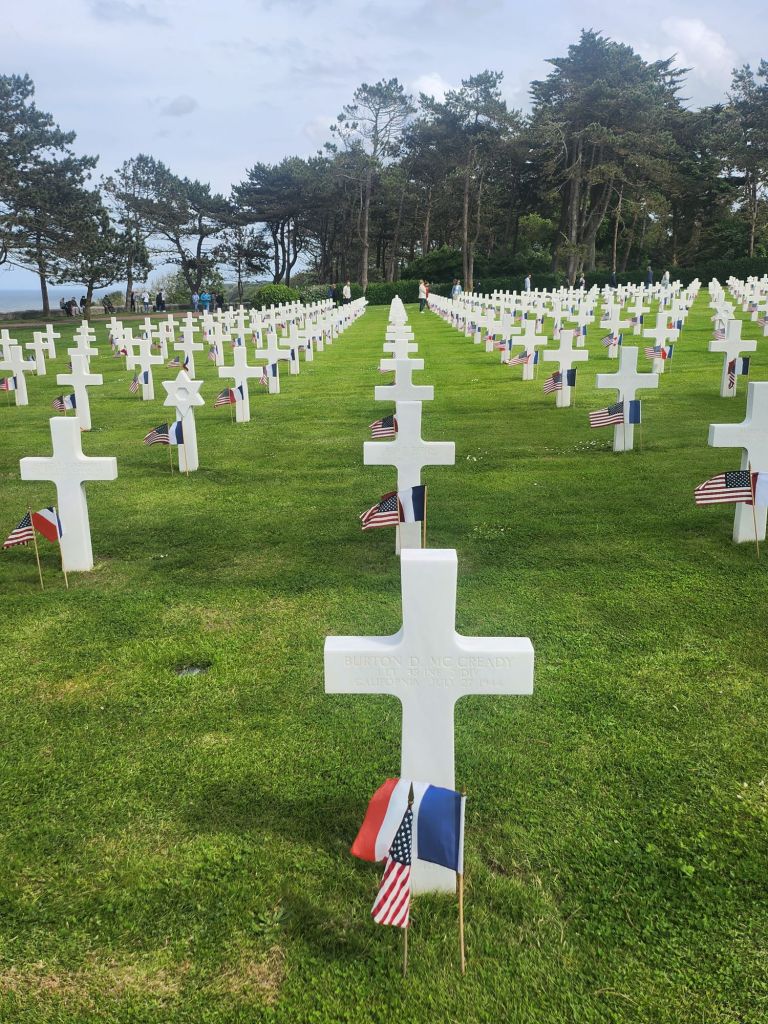
    The American cemetery.   The sheer number of graves is overwhelming, and there is something powerful about the simplicity and symmetry of the layout.

    I found the grave of my mother in law’s World War II pen pal, who was killed in actionin July 1944.

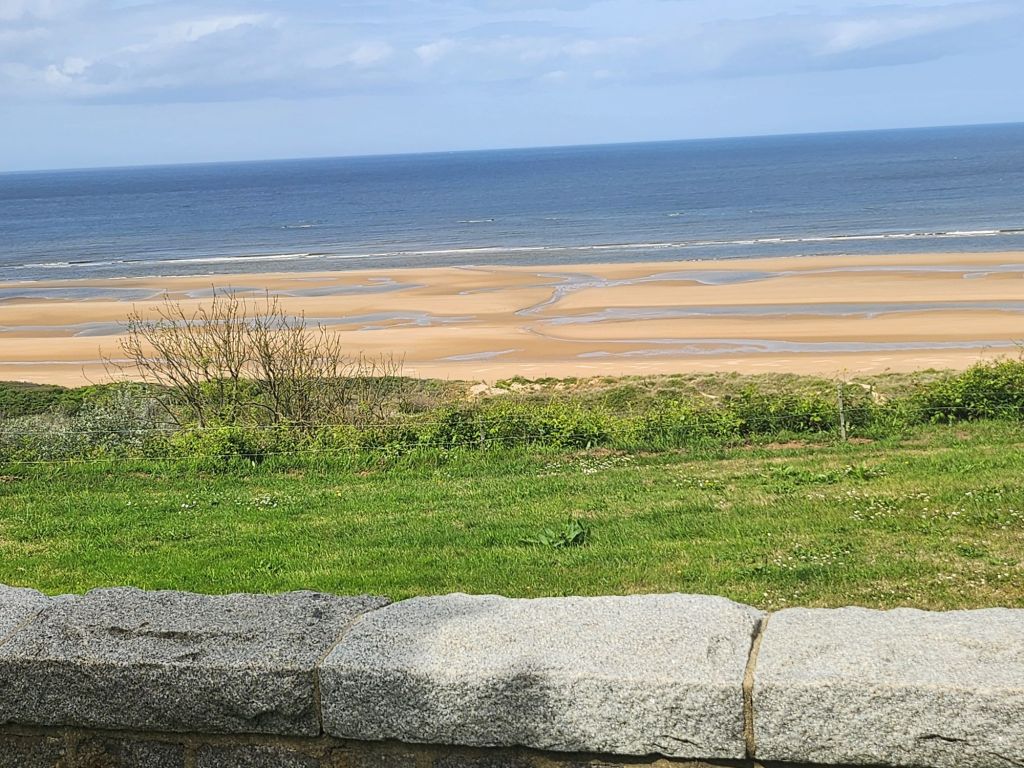
    The view of the beach from the American Cemetery on the bluffs overlooking the beach.  It’s a miracle anyone could have survived landing on this beach while being shot at from this height.

    May 26 

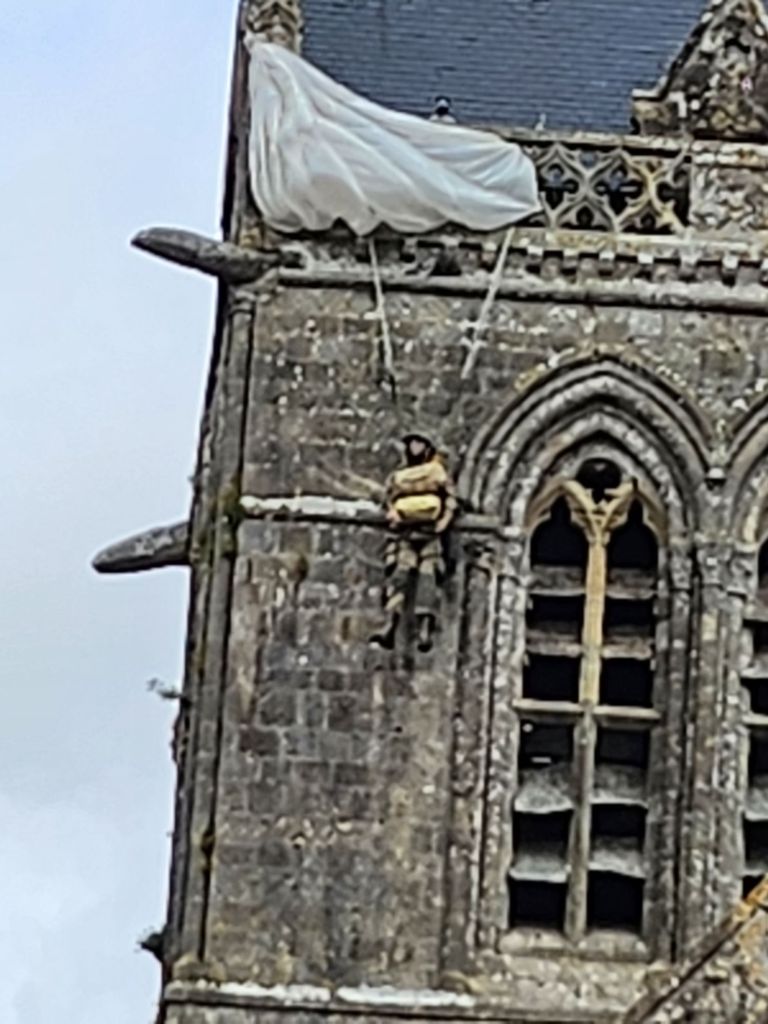
    Spent much of the day seeing sites related to the paratroopers who were dropped behind German lines the night before D-day to take bridges and sow confusion.  The village of St.-Mere-Eglise has kept a memorial to a paratrooper whose chute got caught on the steeple.  He played dead for two hours, then was captured but got away a few hours later in the chaos.

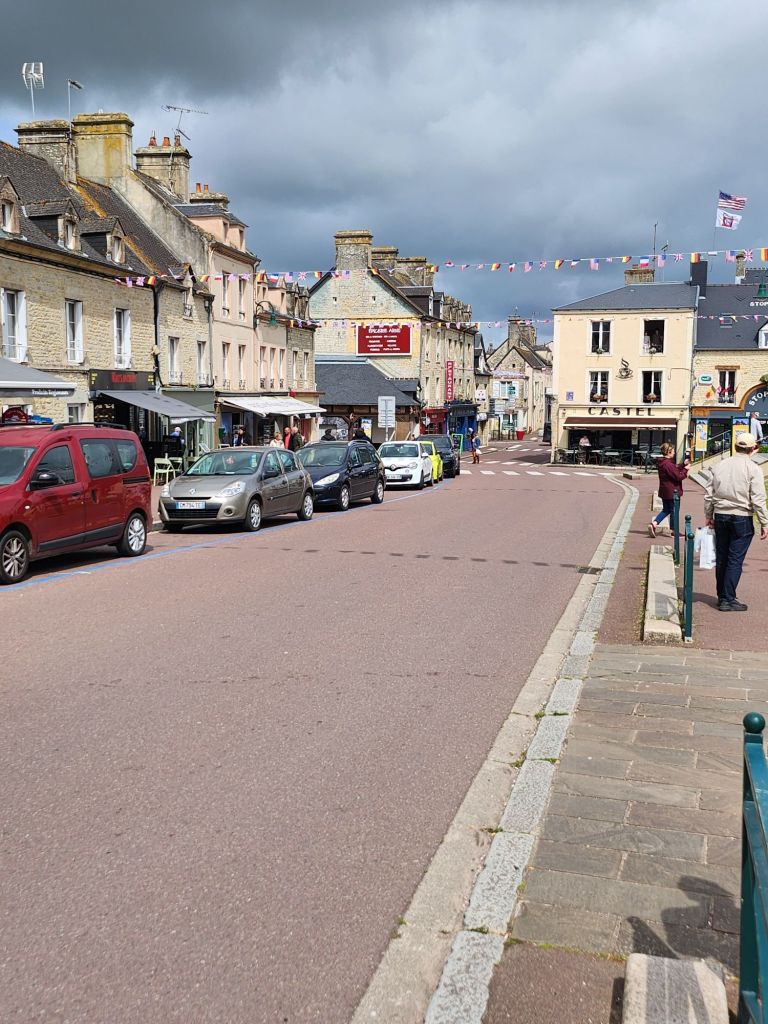
    The St. Mere-Eglese main street where we had lunch.

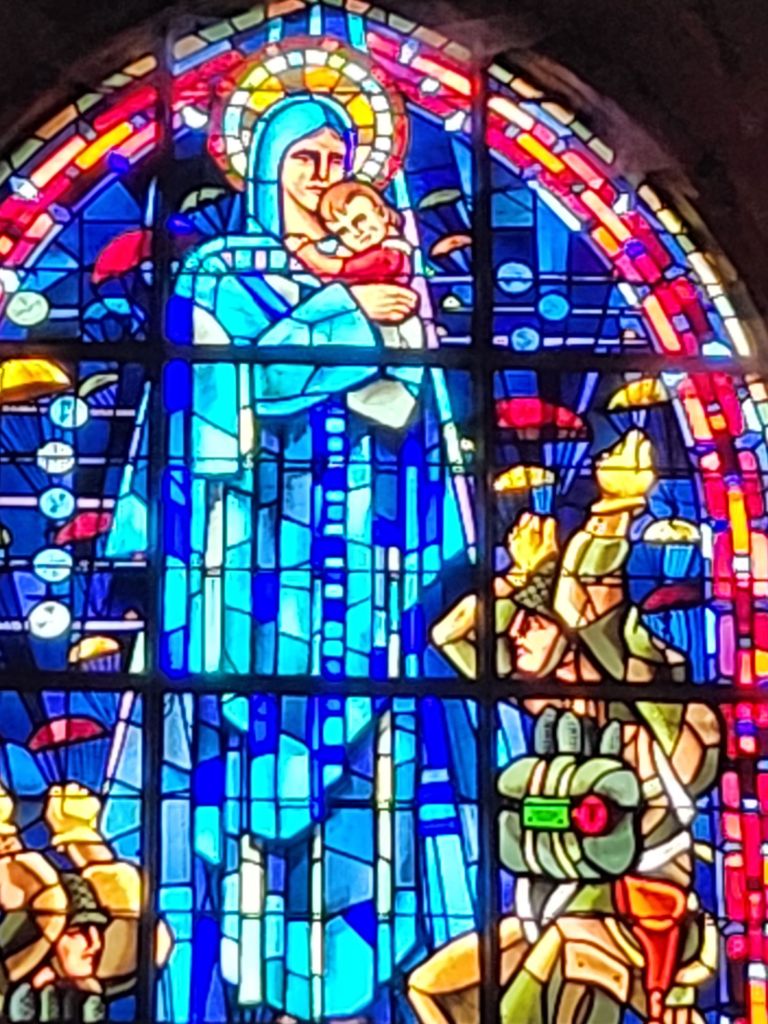
    The stained glass window in the church at Ste. Marie du Mond, with Mary blessing the paratroopers.

    A replica of one of the D-Day landing craft.  I had assumed they were made of steel or some other bullet proof material but they were in fact made of plywood.

    No photos from the German cemetery.   Any sense of historical interest was overwhelmed by moral revulsion.  I and several others did a quick walk around the perimeter and then sat on the bus while others did a slightly longer tour.

  • Portsmouth and Caen, May 23

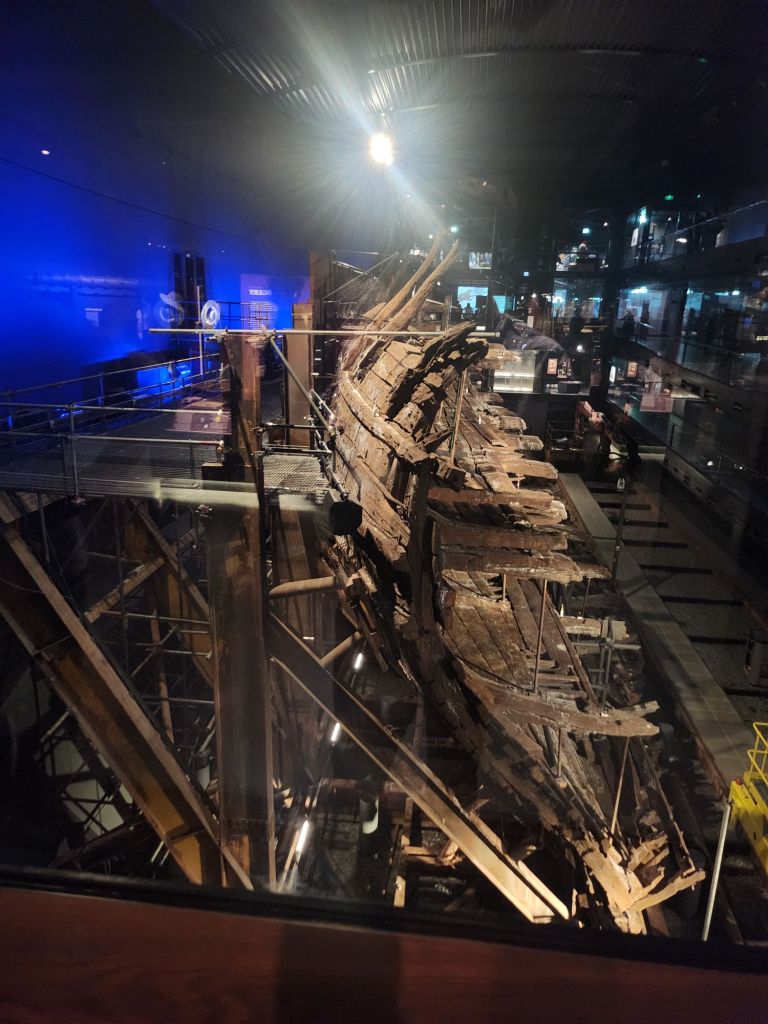
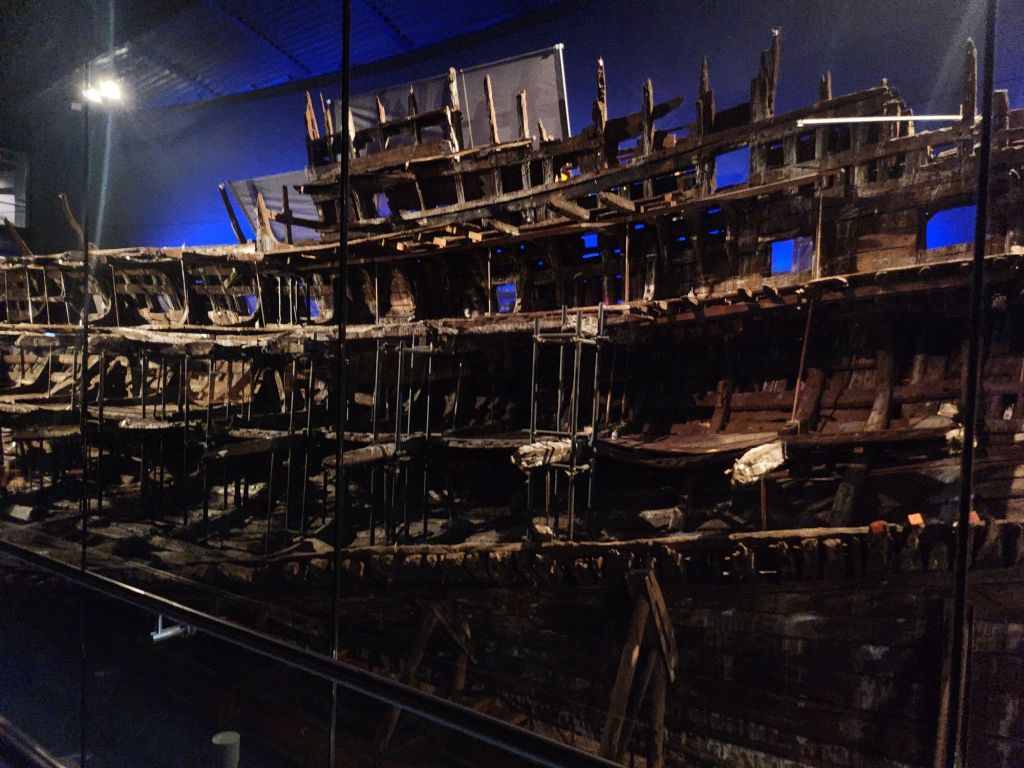
    Tim and I were back at the Portsmouth Harbor and Shipyard, this time to tour the Mary Rose, a ship built for Henry the VIII in 1512.  It sank in front of him in 1547 in the harbor during an inconsequential naval skirmish with the French.  The leading theory is that when it turned too suddenly, water sloshed in through open gunports, which caused the weight to shift so that more water poured in, which caused it to tip over.  It sanked into the mud of the harbor and stayed there for more than four hundred years. 

    It was discovered by a team of amateur divers, who had a general idea where to look from archival research.  When they found the first cannon with Henry’s royal seal on it, they recruited an archaeologist to make sure they were doing it right; she got tired of hearing about all the exciting finds from divers returning to the surface so she got her scuba certification too.  When the significance of the discovery became clear they got a lot of government and foundation money to finish the job but it still took a decade to raise 19,000 cups, cutlery, chests, weapons, tools, armor, etc. to the surface.  Then they raised the half of the ship that was left, preserved because it was buried in silt.  They managed to pull it up all in one piece somehow.  Then it took decades more to preserve the timbers, and design and build the museum, which finally opened in 2013.

    As a result the museum is a lot more sophisticated and higher tech than the HMS Victory exhibit we saw yesterday.   You are greeted by a holographic lifesize Henry the VIII, who gives you the background.

    Then it’s into the display area itself, with a gigantic windows through which to see the ship.

    Some excellent descriptions of the  archaeological sleuthing.

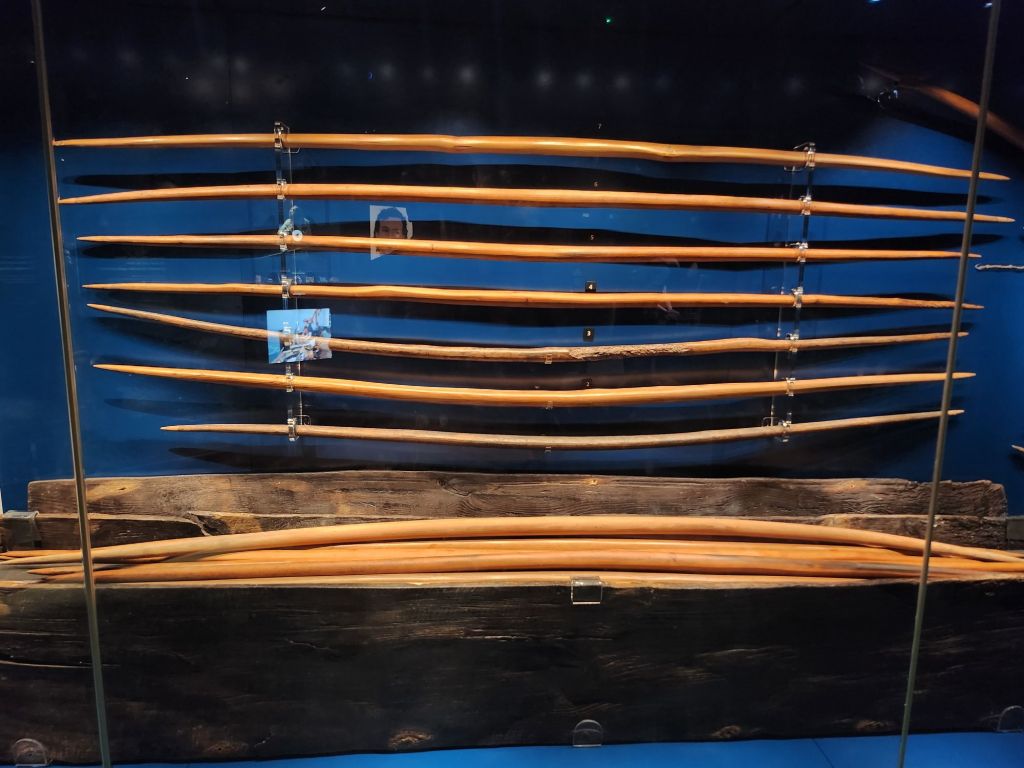
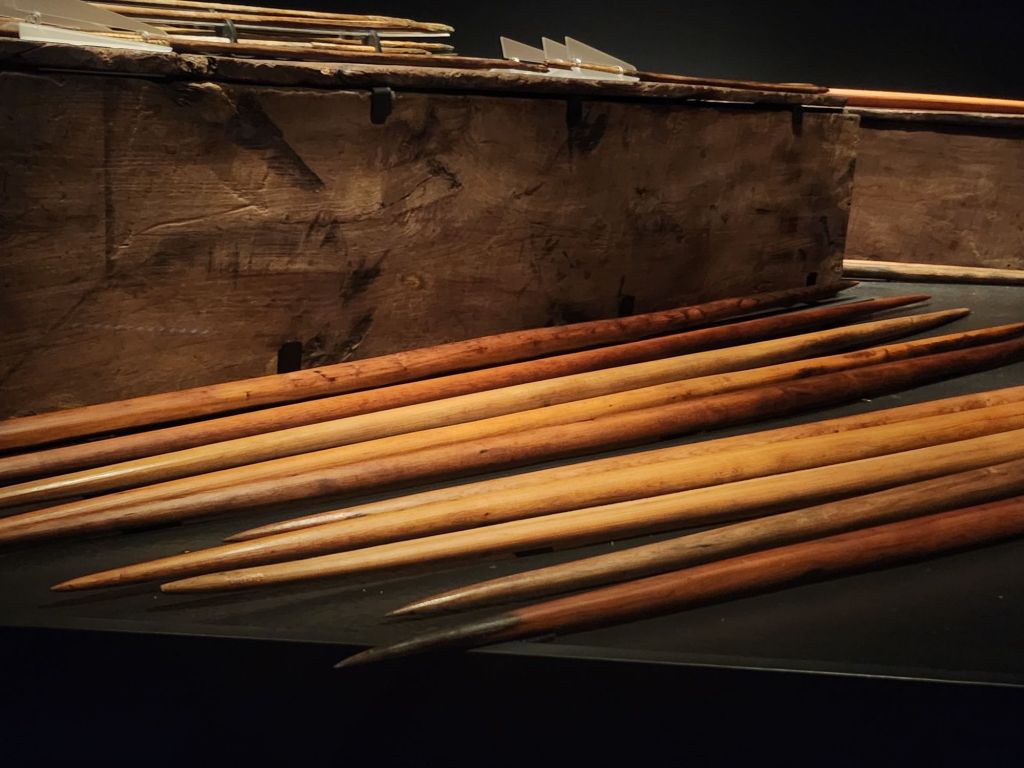
    And finally, a solution to the longbow mystery that arose at the Tower of London. One of the docents explained that prior to the discovery of the MR there were only three historical (i.e. not recreated) longbows in the UK.  They uncovered 154 more in the wreckage, which allowed longbow scholars (of whom there are apparently a surprising number) to get a much better idea of how the weapons worked. 

    At 3 we took the ferry from Portsmouth to Caen for the next phase of my travels.  Posting may be lighter because I will be socializing more (and because I’m not sure that anyone’s reading).

  • London and Portsmouth, May 23

    Tim and I took a morning train to Portsmouth.  Leaving London. I realized we had spent all our time in the eastern part of central London, near the City and St. Paul’s.   In my previous stays I have spent my time in more westerly areas, Westminister and the West End.  And I’ve never spent much time out of central, tourist London.  It seems like it would take a month at least to scratch the surface of all London has to offer.

    Portsmouth is both a working port and naval base and the site of several significant historical sites.  We spent the afternoon touring HMS Victory, the flagship of Admiral Horatio Nelson at the great 1805 Battle of Trafalgar, in which the British fleet destroyed a larger Spanish and French one and extinguished any possibility of a Napoleonic invasion of Britain.

    The Victory has long been on Tim’s bucket list, in part because of his love for the Patrick O’Brian series of novels about the British Navy in the Napoleonic Wars (although the characters miss Trafalgar).  He persuaded me to read them too; I found them a very well written account not only of the British Navy but also of the manners, vocabulary and mindset of the early 19th century in almost Austenian precision and detail.  Also a great adventure story.   I have tried at boring length to persuade others to take them up, unsuccessfully except for browbeating my daughters into reading one book, HMS Surprise, the most accessible.   Both were polite about it but showed no interest in picking up another volume.

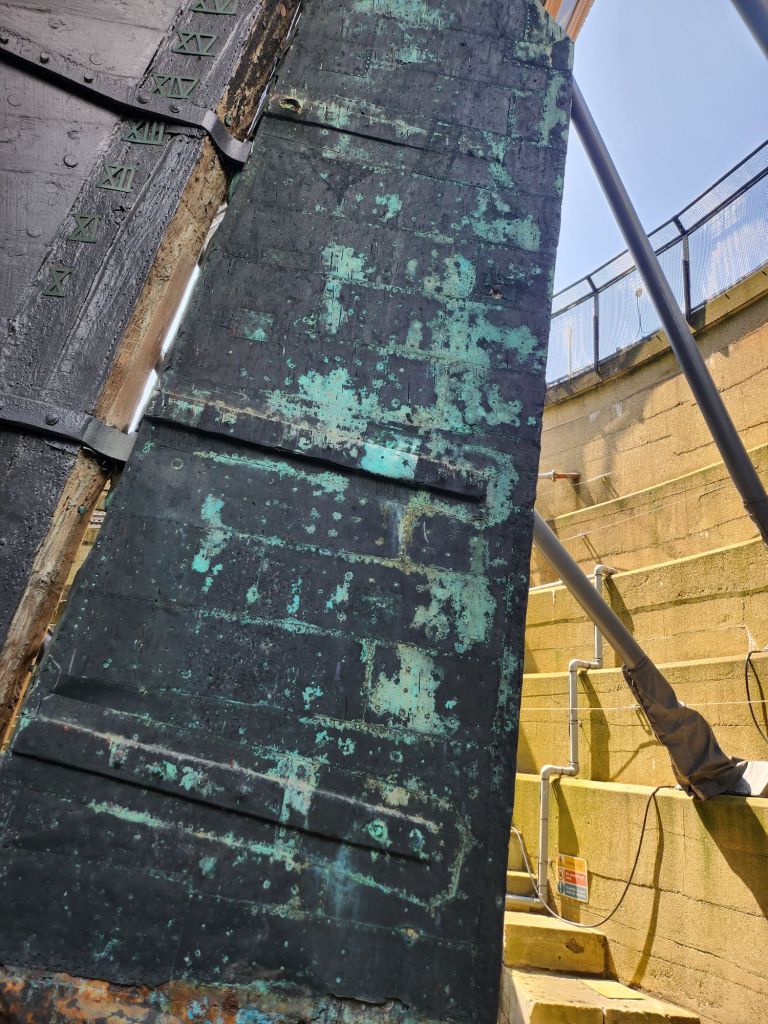
    The Victory is still officially an active ship in the Navy, but it is permanently hoisted out of the water to prevent rot.  Although it’s been out of the water for a hundred years they are currently doing a large restoration project to replace a lot of rotted beams and planks, many of them gnawed by the deathwatch beetle.  The ship is in a giant shed, with the masts down, so you don’t get any sense of being on the open sea.  I avoided hitting my head on low ceilings or falling down steep stairs.

    We followed an audio tour describing nelson, the ship, the battle and life in the Navy in general i.e. the fact that sailors consumed 5000 calories a day of (terrible) food and half a pint (four shots) of strong rum.  The tour was decent but pretty low tech and probably hadn’t been changed in 30 years.  It didn’t really get into what made Nelson so successful, which was the audacity to steer his ships straight at the other fleet, to bisect their line so his ships were firing down the length of the enemy’s, instead of just staying parallel to the enemy and firing from a distance.

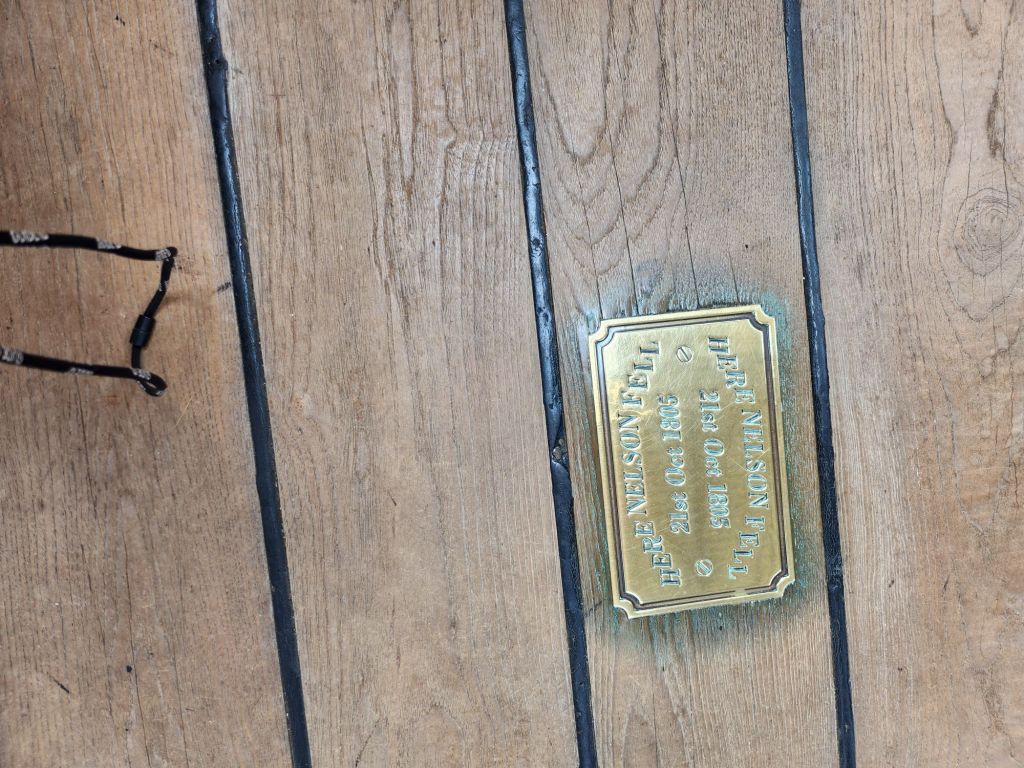
    The spot where Nelson was shot by a French marksman at the moment of triumph.

    The spot belowdecks where he died a few hours later.

    The Victory’s keel, made of pieces of wood supposedly held together by “pintles” and “gudgeons,” which I suspect are words made up by sailors to test the gullibility of landsmen. 

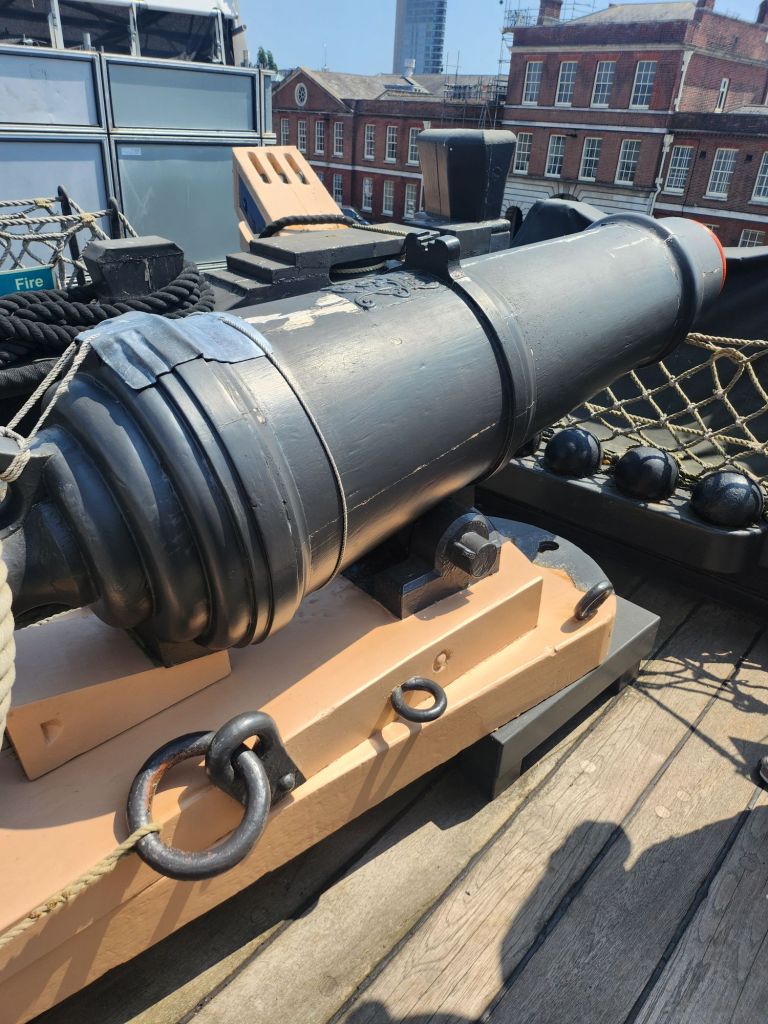
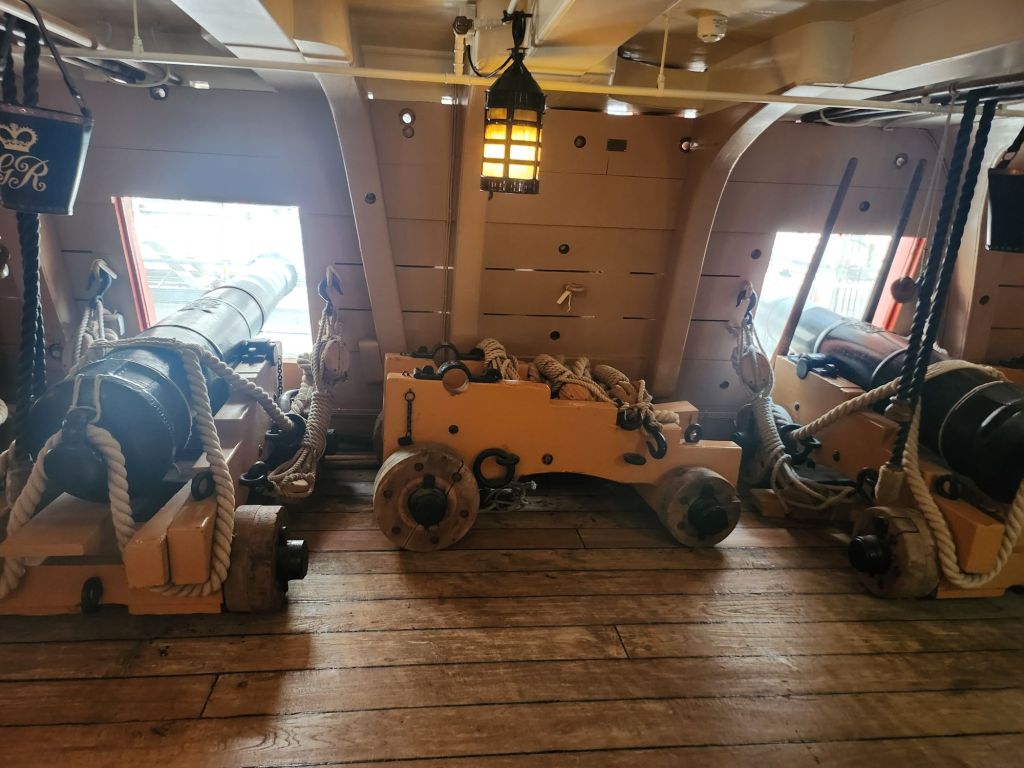
    Other photos.

    We also took a boat tour around the harbor.  The guide pronounced the letter H as “haitch” instead of “aitch” which charmed me every time he said HMS, as he did a hundred times describing ships in the military part of the harbor – “haitch em ess. “

  • London May 21

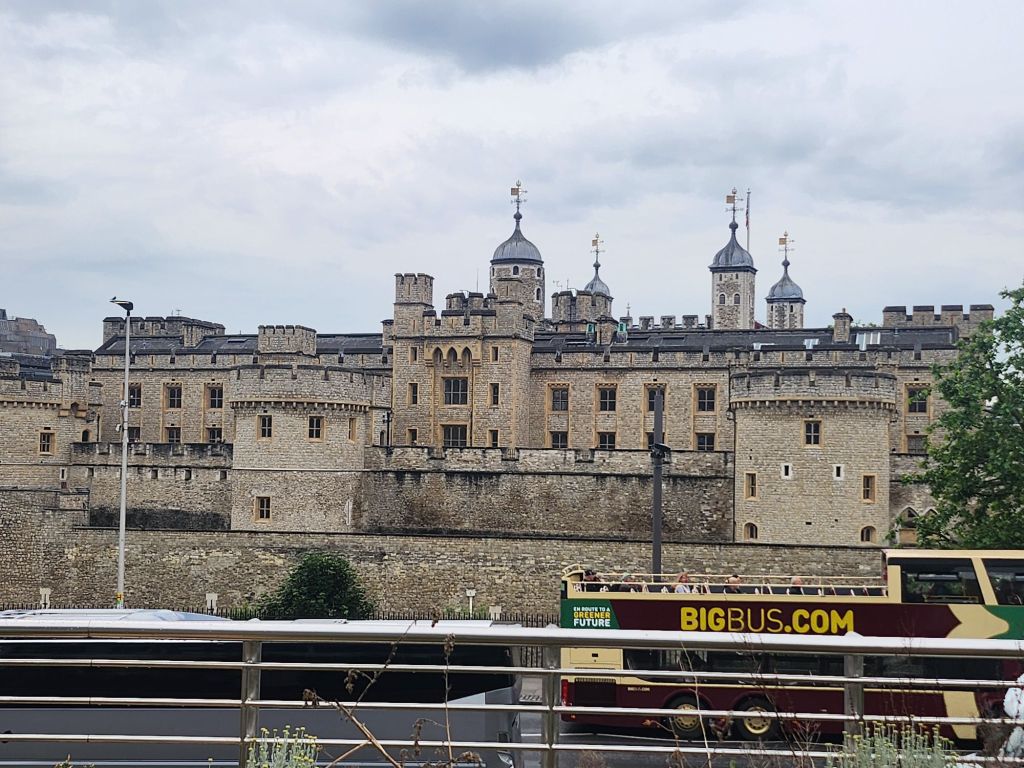
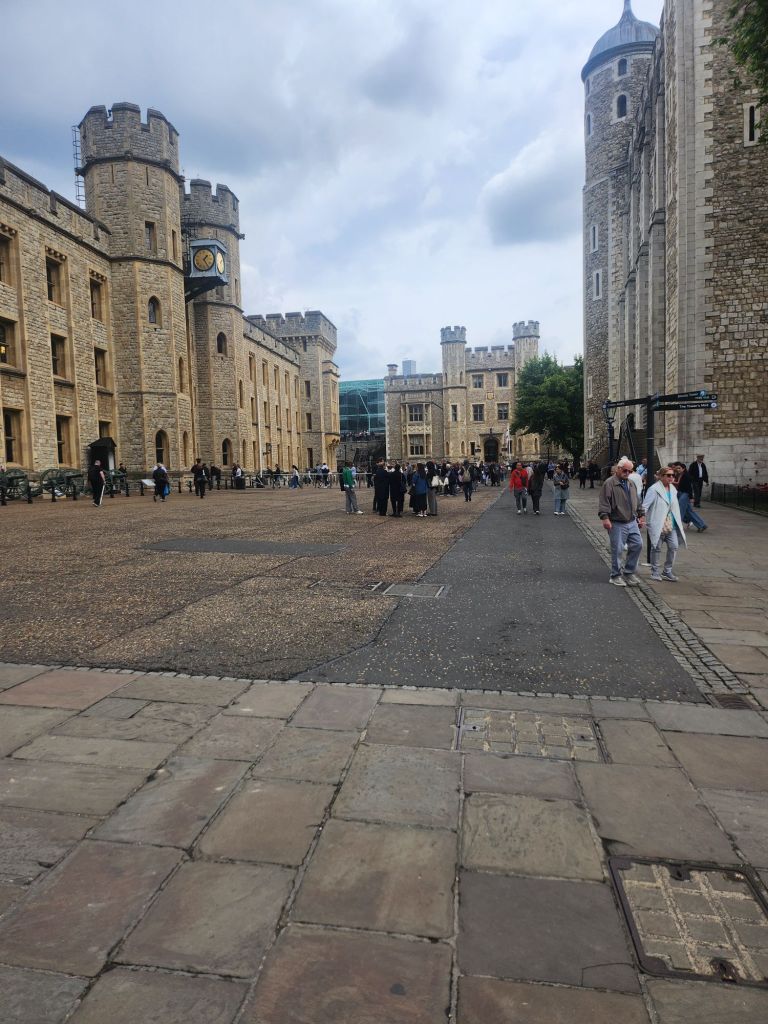
    Spent half the day at the Tower of London.  It was a much larger complex than I’d imagined or remembered extremely vaguely from 1979.  The visitor map and the placards did not provide any overview of the history of the place, but I gather from what I did read wandering around is that the first building, the White Tower, was constructed by William the Conqueror in the late 11th Century.  In the following centuries kings and then generals built, rebuilt, remodeled, and demolished walls, gates (land and water), palaces, barracks, vaults, treasuries, prisons and battlements, because of perceived military necessity, desire to display power and grandeur (including keeping lions and other large wild animals for centuries), luxury, fire, decay and rot, royal whim, and royal paranoia and insecurity, without any unifying plan, theme, design or architecture.  The result is a fascinating mess.

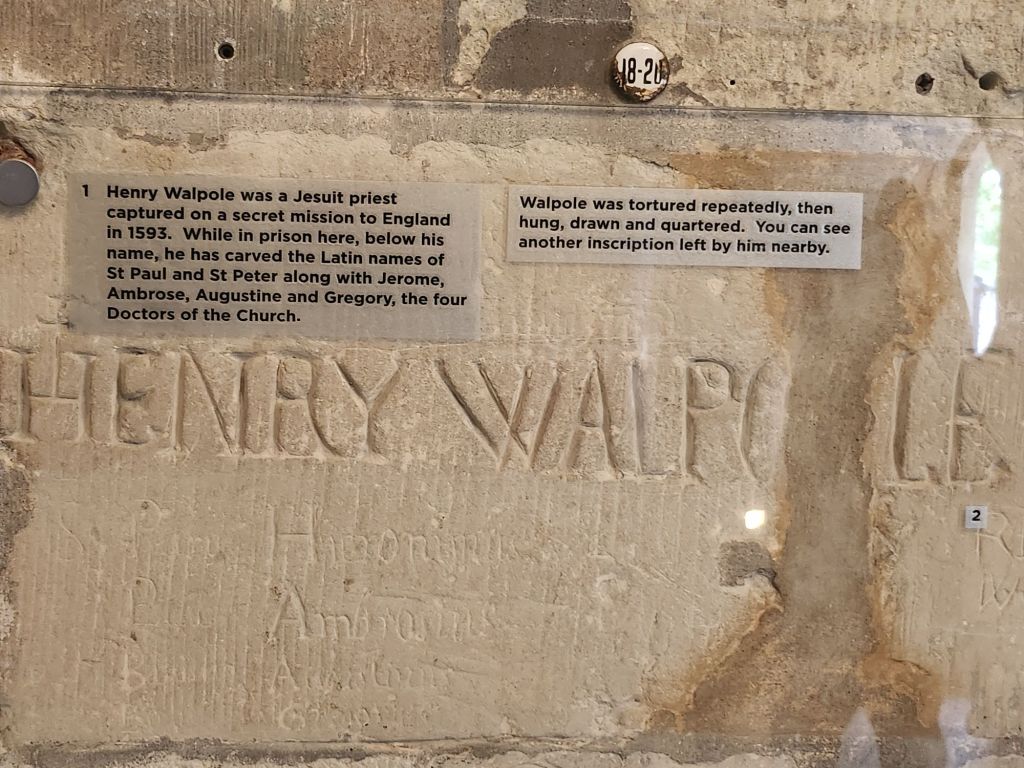
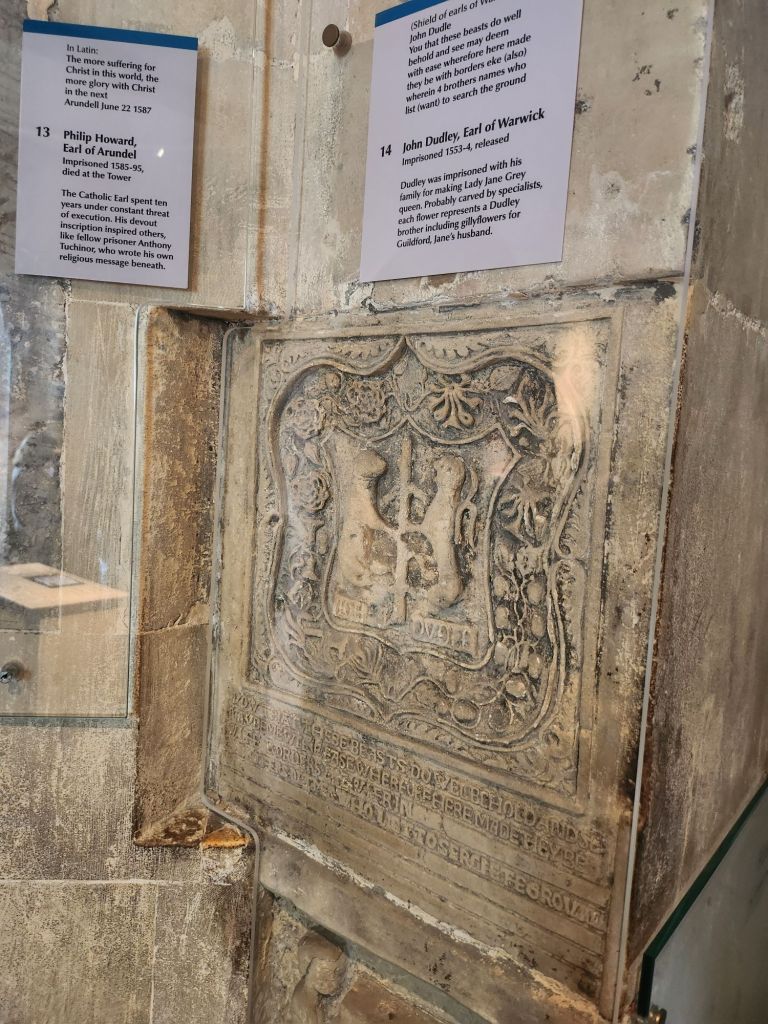
    It never did get attacked except for a Peasants Revolt in the 14th century when the peasants ran in past the unresisting guards, killed a hated tax collector, teased and/or terrorized the royal family (Richard II was 14), and left.  The heyday of the Tower as a prison was in the 16th century under the Tudors, when Queen Mary hounded and tortured Protestants, and then her successor and half sister Elizabeth did the same to Catholics.  The latter carved some remarkably neat, sad and well preserved graffiti into the walls.

    The place names to me evoke fantasy literature – the White Tower, the Bloody Tower, the Cradle Tower, the Bell Tower, the Salt Tower; the Traitor’s Gate, the Jewel House, the Chapel Royal.

    Tim and I wandered the whole complex.  The biggest crowds were for the royal jewel collection, which didn’t do much for me other than learning that the Roundheads under Cromwell melted down or sold the whole collection in the 1650s; when Charles the Second was restored to the throne he had to start from scratch.  So almost all the royal crowns and orbs and other symbols of wealth and power have only been in use since 1661.

    Tim and I were surprised and disappointed to find not a single longbow in the extensive weapons displays.  The longbow was the most distinct and important English weapon of medieval times.  It allowed relatively poor English commoners to hold their own against the French nobility. The Yeoman Guards (Beefeaters, now basically docents) we asked were contrite about the absence and shared  out disappointment.

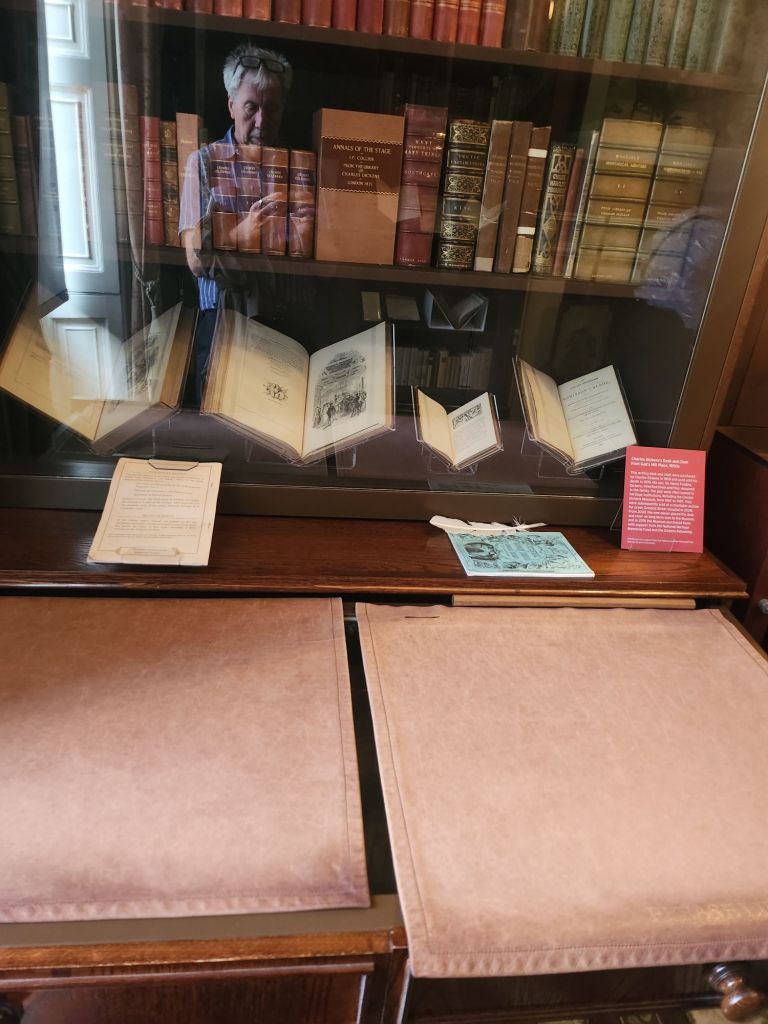
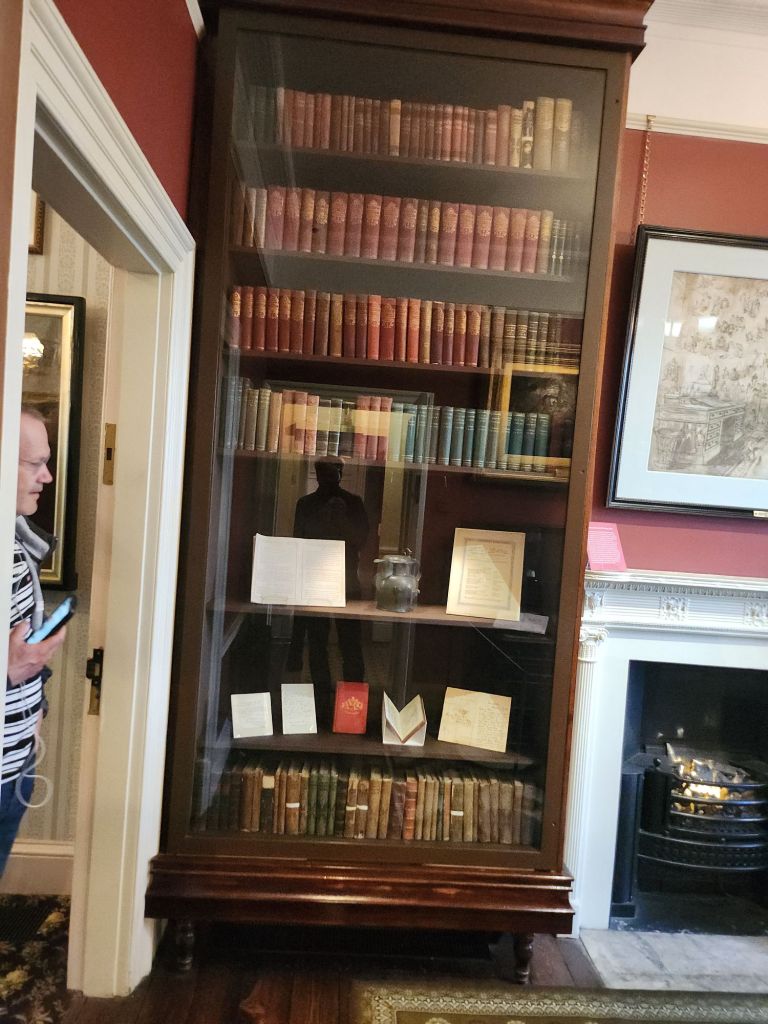
    In the afternoon we went to the Dickens Museum, in the Bloomsbury house where Dickens lived and wrote some of his early, lesser novels, including Oliver Twist.  These novels made him so rich and famous that he moved to more expensive places.  He only lived in this house for a couple years but it’s the only London Dickens residence that survives so they have gathered documents and ugly Victorian furniture and furnishings from every phase of his career.  Here are the least ugly pieces of furniture, his writing desk and bookshelf (with bonus ghost images of me).

  • London May 19

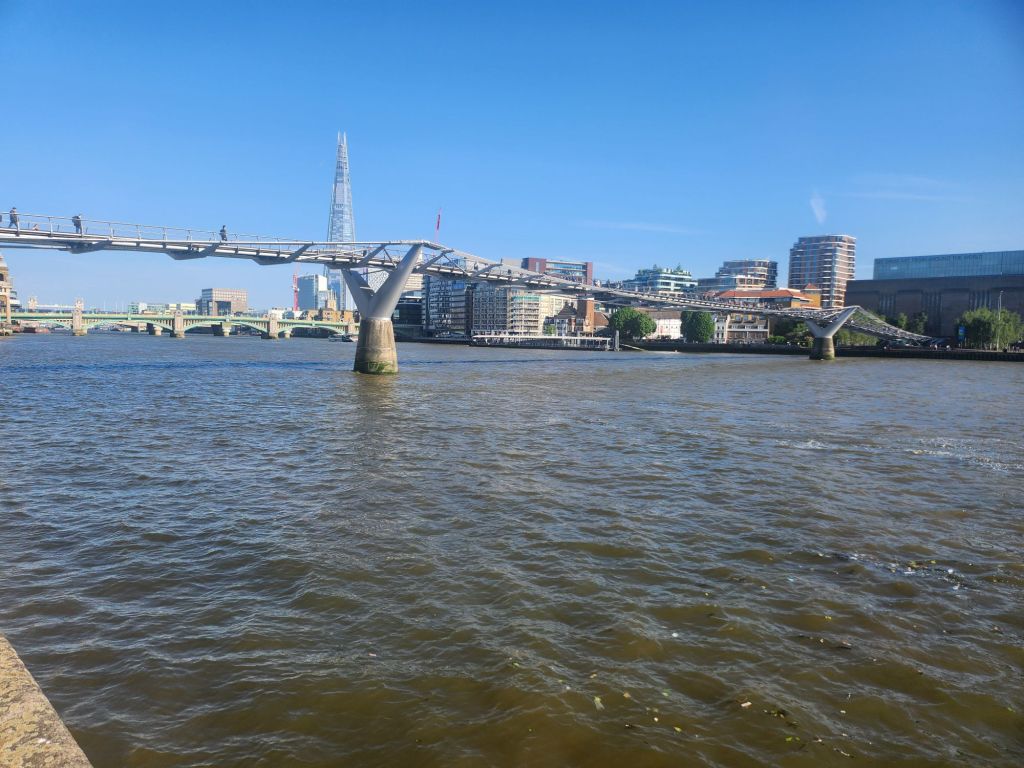
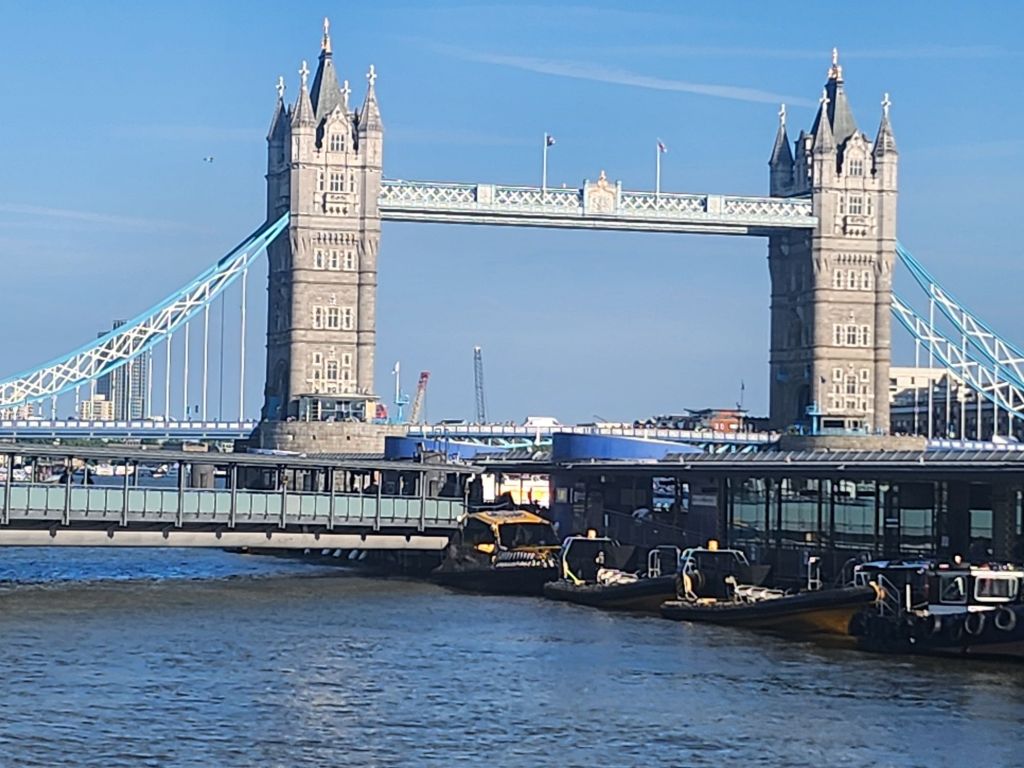
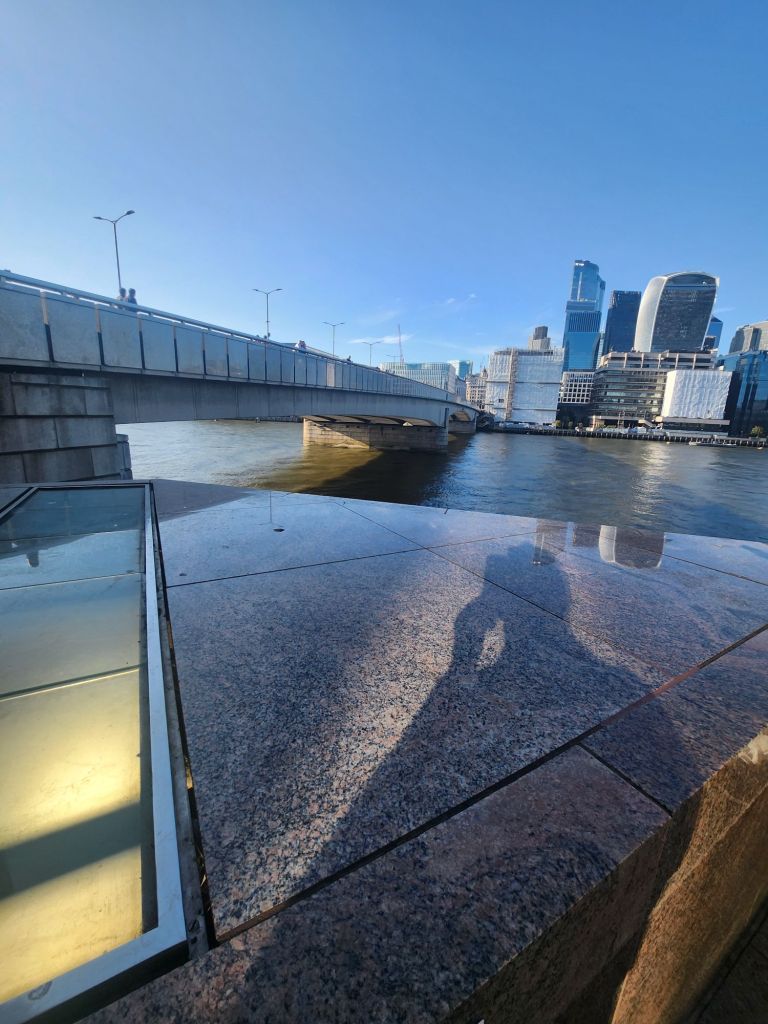
    Arrived in London in the late afternoon after 20 hours of travel, 11 hour time difference. Went for a long walk, down, across and up the Thames. Southhampton Row to the Kingsway Aldwych to the Strand to Arundel Street to the Embankment, then across the Millenium Bridge to the South Bank.

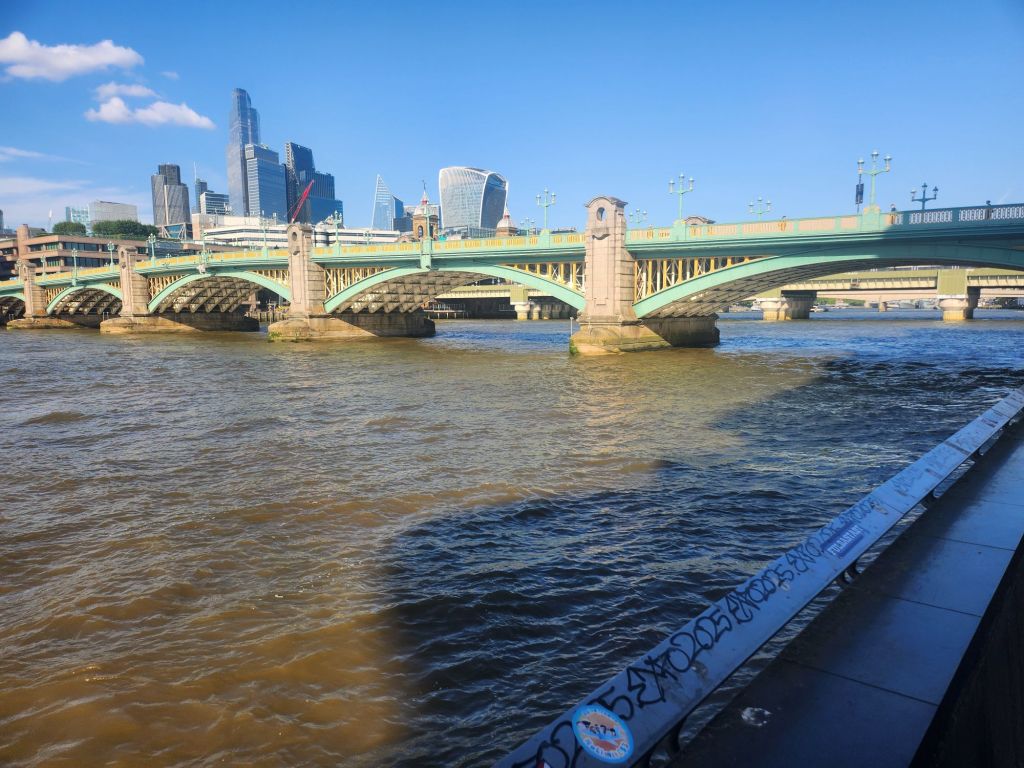
    Down the river and across again on Southwark Bridge.

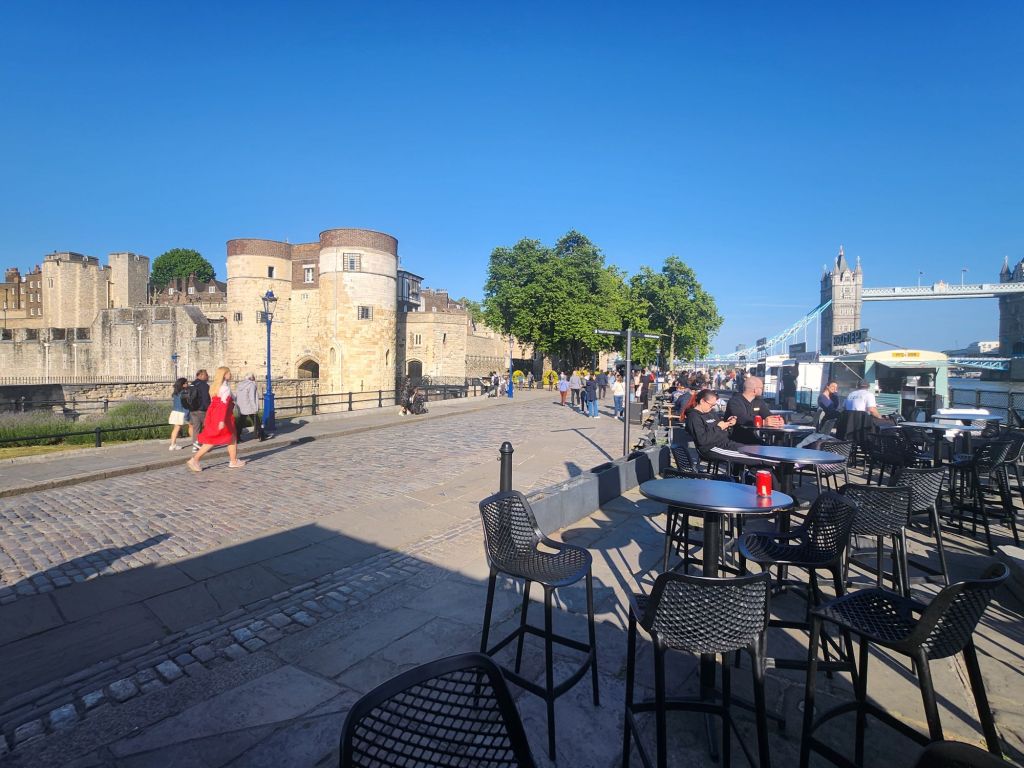
    Past the Tower with its ancient food trucks.

    Across Tower Bridge.

    Then back up the river to and across London Bridge (surprisingly the least distinctive in appearance).

    Although it was a gorgeous sunny day, it sounds like a more romantic or Dickensian then it felt. I thought a lot about the differences between now and my semester here in 1979. Gone are most visible class markers — no older businessmen in bowler hats, no younger ones in sharp suits; very few attempts by either gender to be stylish or distinctive; no obvious working class dress. Almost everyone in t-shirt, athletic shoes, jeans and hoodies. I was slightly above average in appearance because I wore a collared shirt and dress slacks.

    Also gone are the very distinct youth tribes of 1979, each with itscown style of dress, music, drug of choice and degree of menace: punks, skinheads, mods, teddy boys (sharp dressers into 50s Amerian music), glam rockers, metalheads, even a few leftover hippies.

    The streets also seemed less distinctive, more Americanized: Starbucks (which didn’t exist in 1979), McDonalds, KFC. No fish and chip shops, only a few pubs. I’m in the heart of tourist London; maybe other parts have retained their character better.

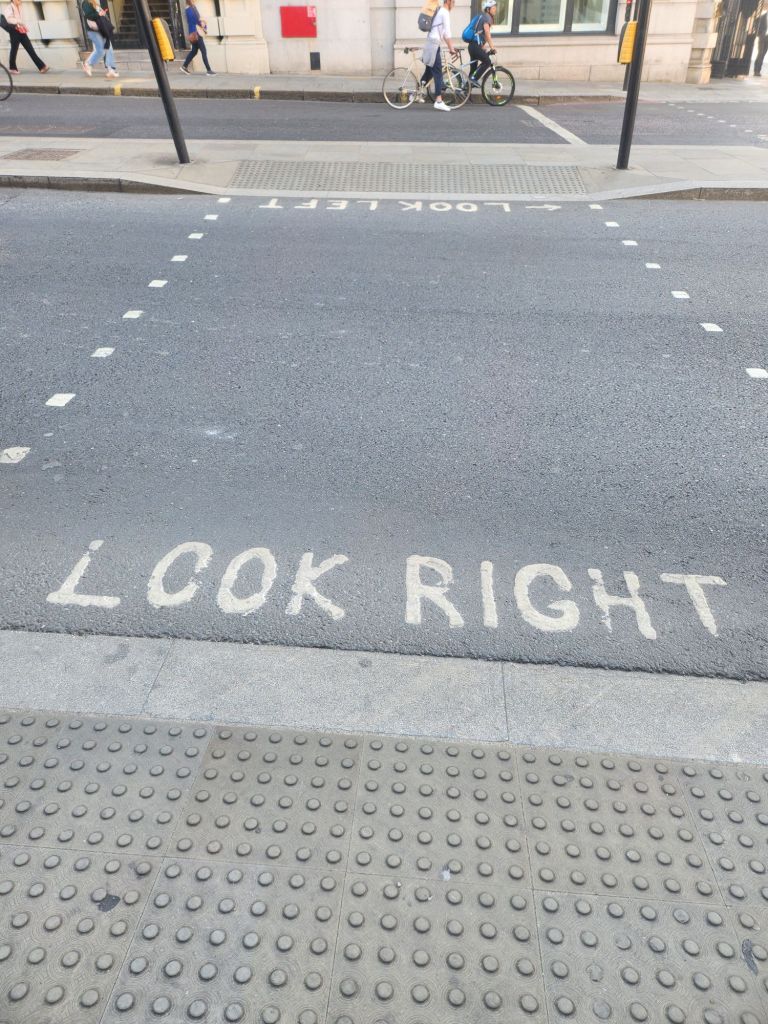
    One great improvement: the street crossings now have markings telling you which way to look before you cross.

    20250519_1742043073501870131162131

  • London May 20

    Went out for the day with my friend from fifth grade, Tim. As we left our hotel they were putting up an elaborate floral arrangement around the hotel entrance.

    20250520_1021033141777631103003016

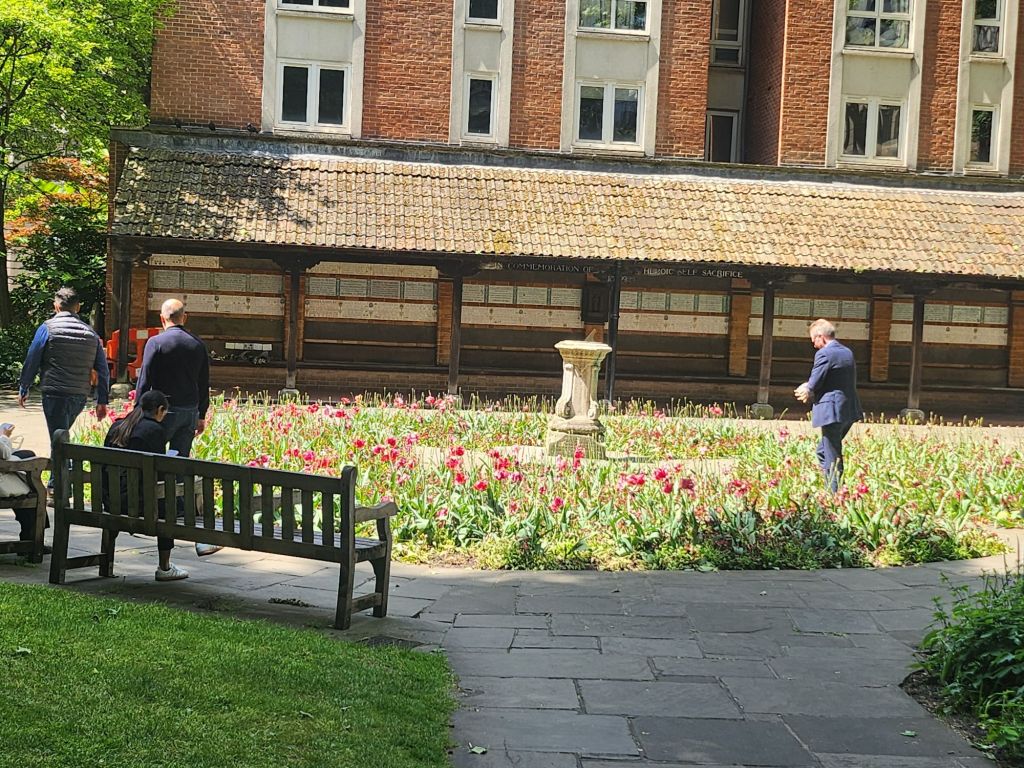
    We went on a walking tour of sites associated with the lives and works of Dickens and Shakespeare. Our guide was an actor who did some dramatic recitations of passages from both authors. Along the way we stopped at half a dozen pretty little or medium-sized parks or nooks or squares or other public spaces, most with benches and gardens. We passed by a dozen more. Most have been there since medieval times or before, others were cleared by the Great Fire of 1666 or the Blitz of 1941.

    I annoyed the guide by asking her questions she couldn’t answer about real life locations from Bleak House – the street crossing swept by the orphan Jo, the cemetery where a character (no spoiler) died of grief and shame.  Then I embarrassed her by correcting (privately) her error of claiming that a speech by Thomas More was a response to the revocation of the Edict of Nantes, which as every schoolchild knows happened 150 years after More’s death and almost a century after Shakespeare’s. 

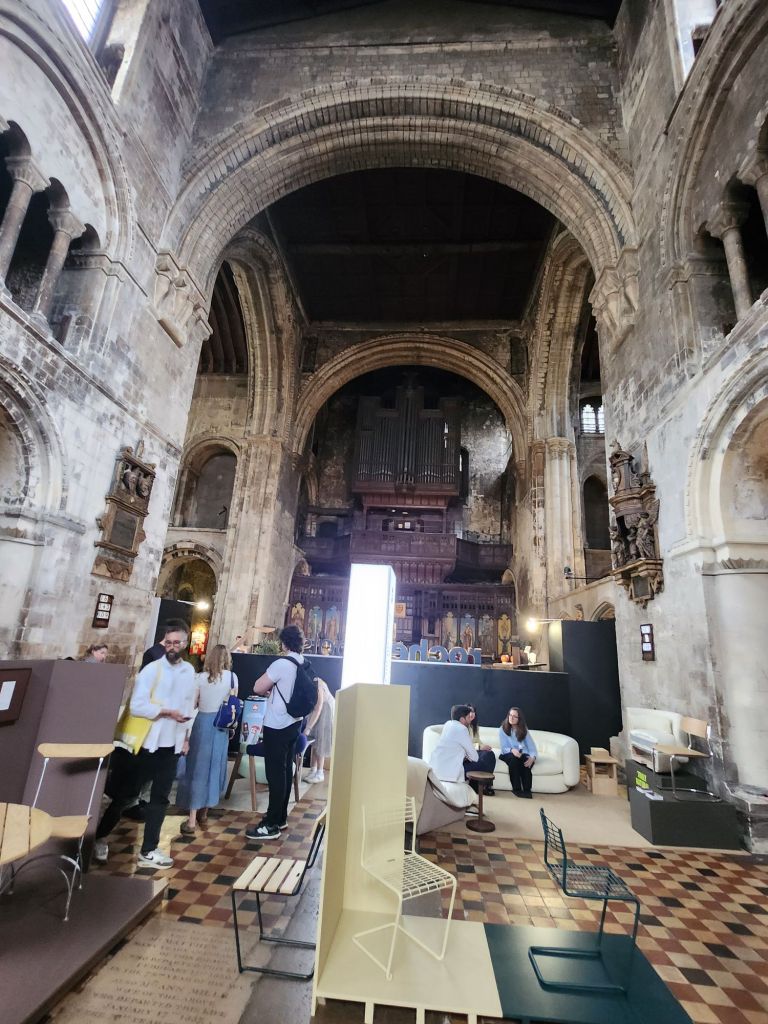
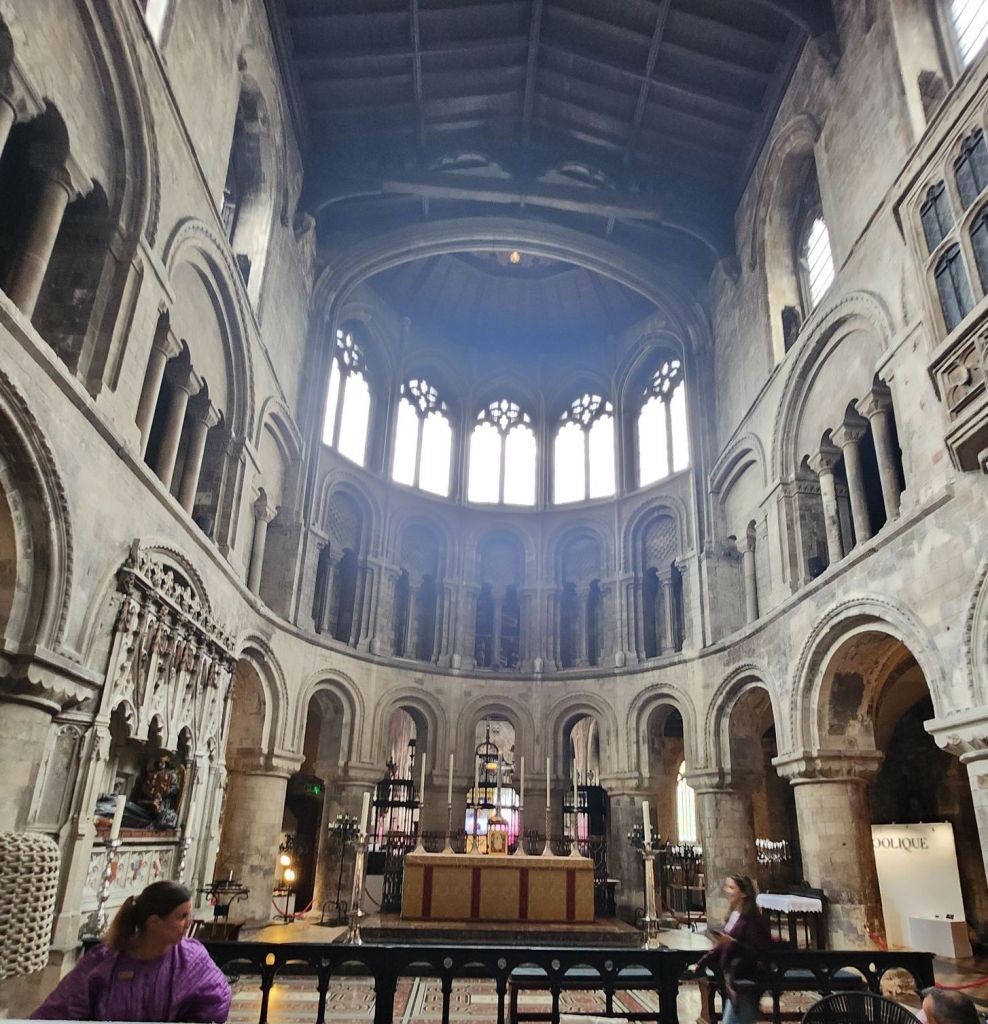
    After the tour Tim and I returned to a couple sites that our guide had mentioned. One, St. Bartholomew’s church, is so iconic that it has been used in a lot of movies, including Shakepeare in Love and The Great Muppet Caper. Here’s how it has looked since 1123, from Google images:

    But the church was hosting a “Church of Design” event. According to the event website, “the 900-year old medieval church will provide a breathtaking backdrop for cutting-edge contemporary design products covering all types of interior design.” They had chopped the nave and choir into display booths, which rather obscenely obliterated any sense of peace or divinity.

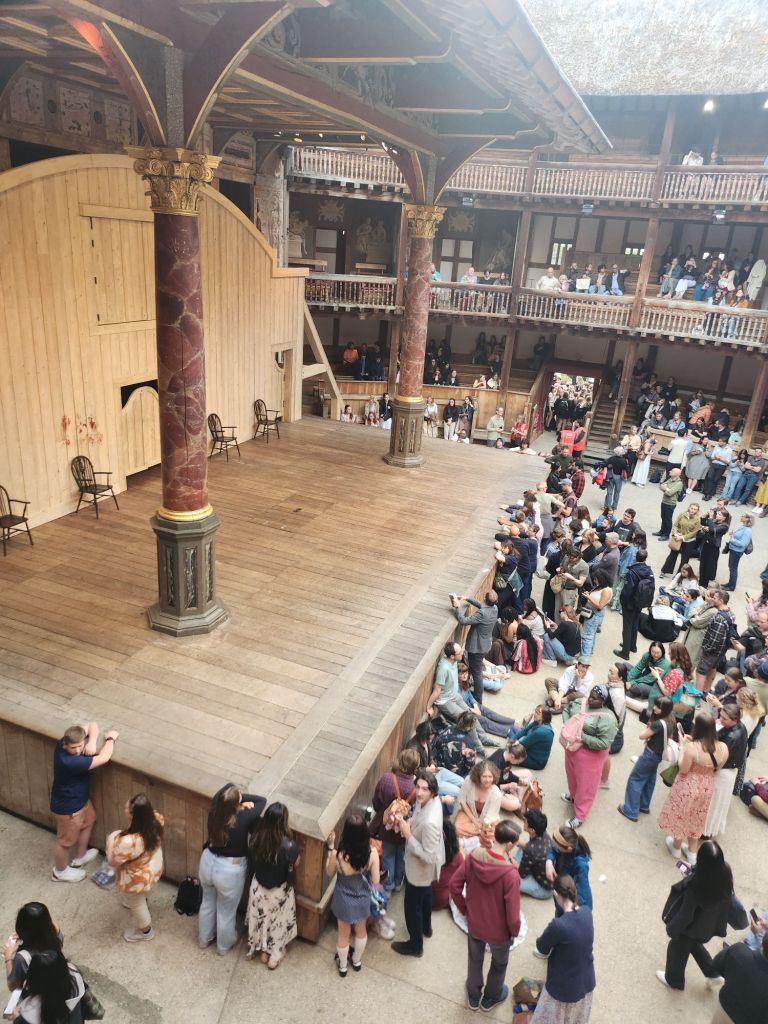
    In the evening we went to Romeo and Juliet at the Globe, the recreation of Shakespeare’s 16th century theater on the South Bank of Thames. They set the production in the Amercan Wild West for no reason that Tim or I could discern — Wild West set and costumes, guns instead of swords, an occasional yeehaw, some sort of square dancing, but it was kind of incongruous with the Italian names for peope and places. The actors were not wearing microphones so they needed to project their voices, as all actors had to do from ancient times until very recently.  Requires a very different skill than with a mic.  When they faced away it was sometimes hard to hear but otherwise they  conveyed even quiet emotions well. Acting overall was pretty good except for Romeo, which seems to be a common problem in the productions I have seen. Maybe it’s just really difficult to convey the love at first sight emotions in the text. But this Romeo also seemed to rush his lines, losing the rhythm and making it hard to understand. Juliet and the Friar were the standouts.  But they oddly truncated the ending, taking out the Friar’s recap to the Prince and the parents of what just happened, the grief of the parents, and most importantly the reconciliation of the families.  This made the ending pretty abruptly, and also broke the promise made in the prologue.

    A lot of students in the groundlings including three 12 year old I watched occasionally who were restless through the beginning but rapt at the end.