Three hundred fifty miles from Ljubljana to Sarajevo on the highway. No idea how far it was on the route my busses took, but the trip lasted 12 hours. The first leg, Ljubljana to Zagreb nonstop, was all highway. The first three hours were filled with trucks, hills, valleys, trees and more trucks – Interstate 70 through Pennsylvania. The last hour was flatter, more fertile – I 71 in Ohio. I had a seat in the front row of the two-decker bus, before a large bug-smeared window.
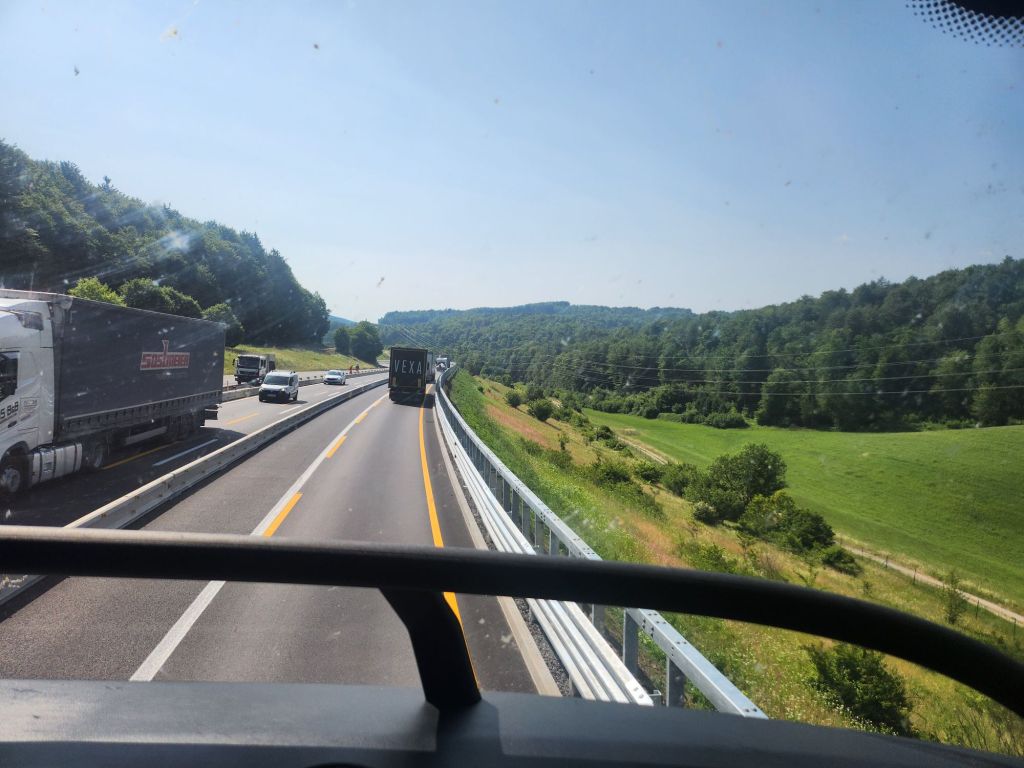
Oddly, the nearly full bus was almost entirely silent throughout the trip. When the Asian-looking guy in the next seat and I were trying to figure out the ceiling vents, he said accurately, with an accent that sounded English, “Not very effective.” I said, inaccurately since we were headed east all morning, “Well, the sun will be off us soon.” He nodded and turned away. That was my longest conversation of the day.
During the hour break in the Zagreb I had an enormous 7-euro “kebab” – excellent pita, lettuce, tomato and sauce, questionable meat. Then to Sarajevo. This part of the trip was definitely not an express — 17 scheduled stops, plus some added in to let people off in the middle of nowhere, as far as I could tell. People did talk softly on this leg.
The landscape started out like it was the first part of the trip, so I read and napped. When next I looked out the window the landscape had turned wilder.
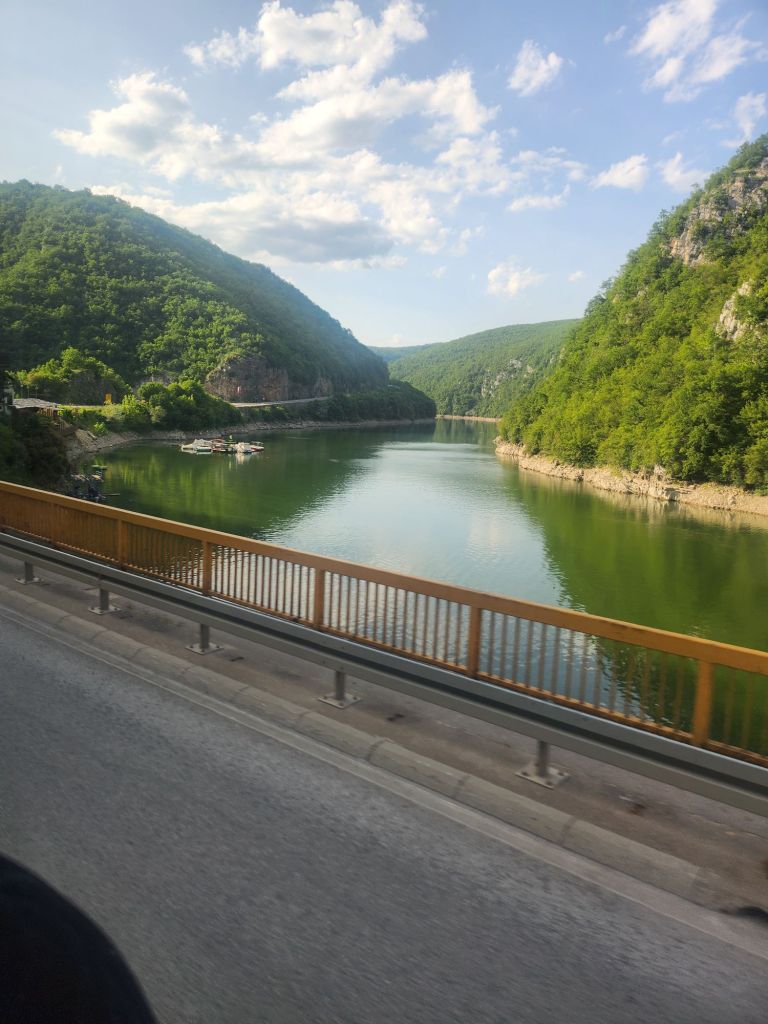
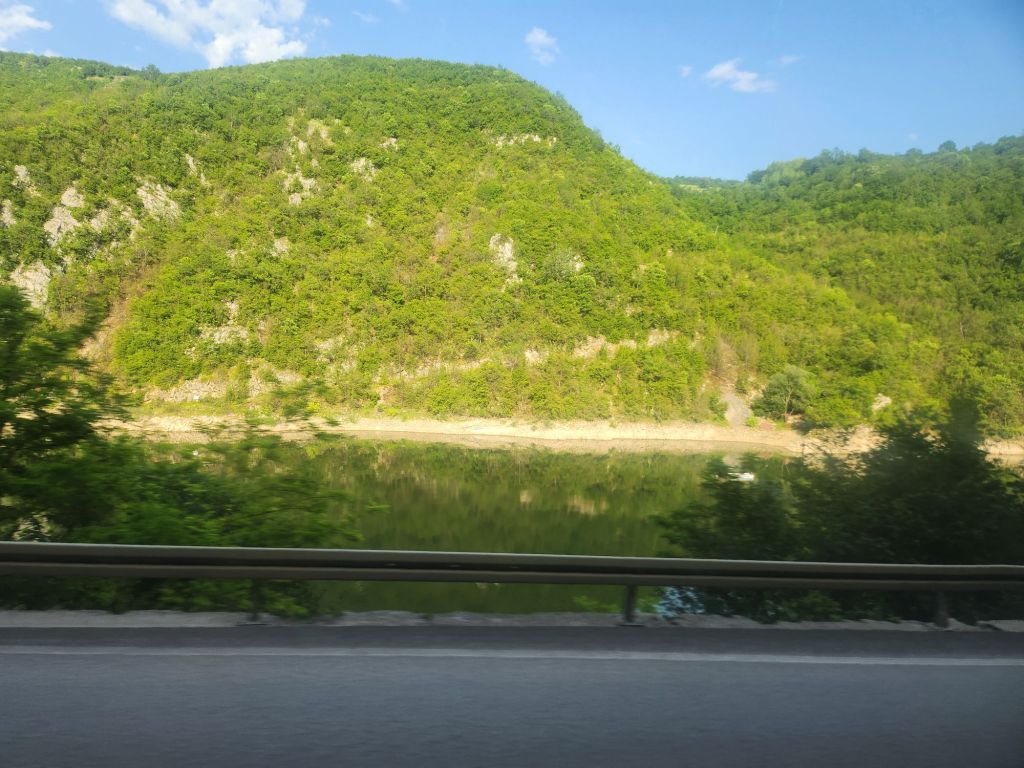
Still dotted with houses, many well kept with large vegetable gardens, others dilapidated, maybe a third abandoned. I learned the next day that some of these houses were left by residents moving to the city, but that most were left vacant by the ethnic cleansing of the nineties, their owners having either fled or been murdered.
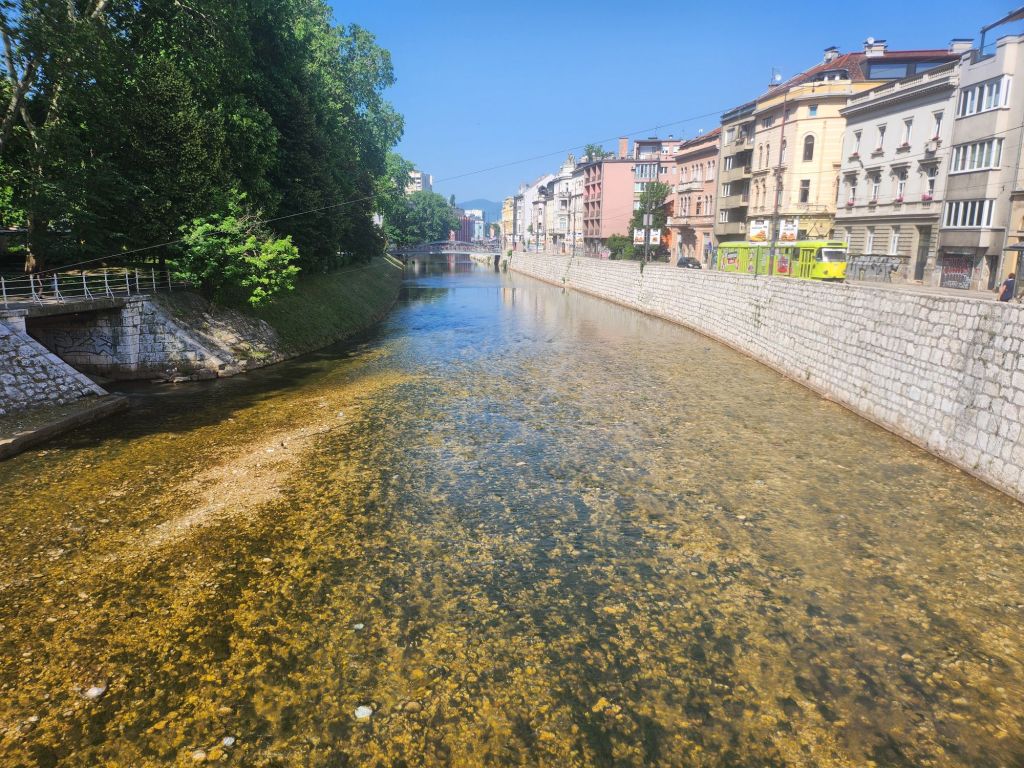
The next day I woke up very early and walked a few hundred yards to the site of the assassination of Archduke Franz Ferdinand, the heir to the throne of the Austrian Empire, by a Bosnian Serb in June 1914. The very strong desire of many Serbs to live in a single country that they dominate was a thread connecting 1914 and 1992. (Serbian can refer to a nationality – someone who lives in Serbia – or an ethnicity, e.g. a Croatian Serb or a Bosnian Serb.) The assassin, Gavril Princip, was part of a conspiracy with five other young men who were pretty inept as assassins. They stationed themselves along the parade route, a road paralleling the Milkacka River, with bombs and pistols. The first two assassins froze and did nothing. The third threw his bomb, missed, took poison which didn’t work, then threw himself in the river, which was only knee deep. The Archduke’s car understandably sped up, so the next assassins, including Princip, didn’t get a chance to do anything. Princip went to a cafe to brood. He was sitting there when the Archduke’s car mistakenly turned up the side street next to the cafe, and started to turn around. Princip came out and shot from ten feet away. His footprints and the location of the car wheels are recorded on the pavement. The place seemed undersized for the most consequential event of the 20th century — the main road, the river and the side street all seem too small.
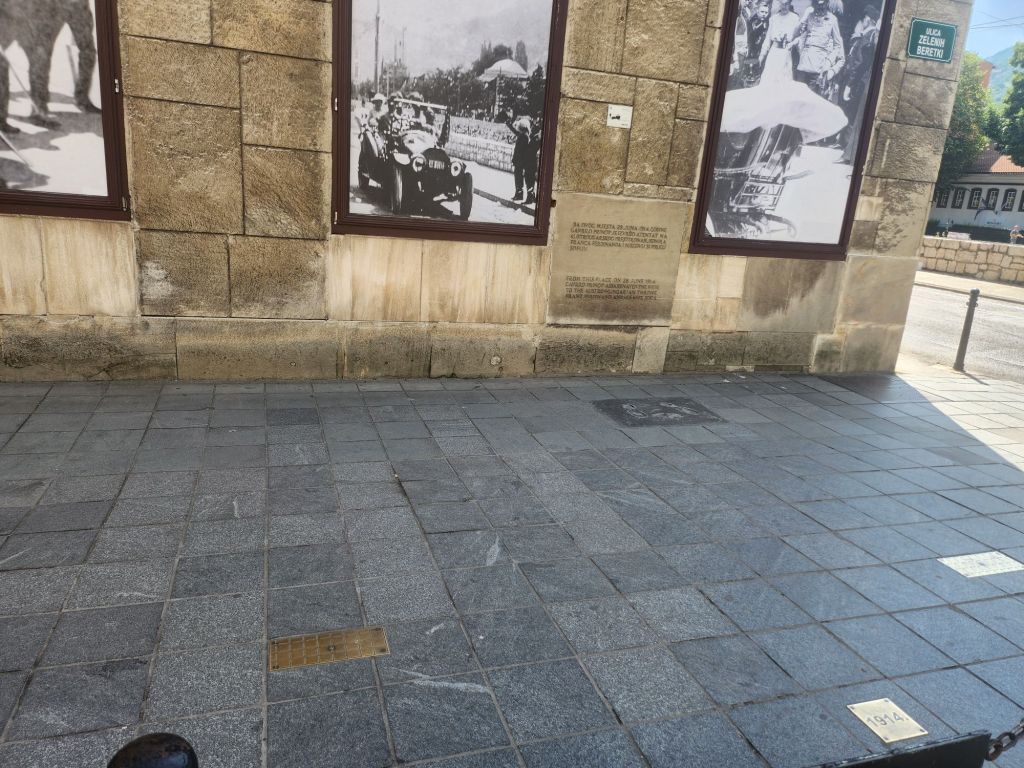

The neutrally worded plaque replaces one erected by Serb-dominated Yugoslavia, which celebrated Princip as a freedom fighter.
I joined a walking tour led by Neno, a Bosniak (Bosnian of Muslim descent) and a passionate Bosnian, committed to a multiethnic state of Bosniaks, Bosnian Serbs and Bosnian Croats. He spoke very quickly in good but heavily accented English, and started with a succinct overview of Bosnian history – four centuries of Ottoman Turkish rule, four decades under the Austrians ending with World War I, twenty years as multiethnic kingdom of Yugoslavia, World War II, 45 years of socialism under Tito and his successors, then the calamities of the nineties. He covered that war but also talked about other parts of Bosnian history, as well as food, architecture, and religion.
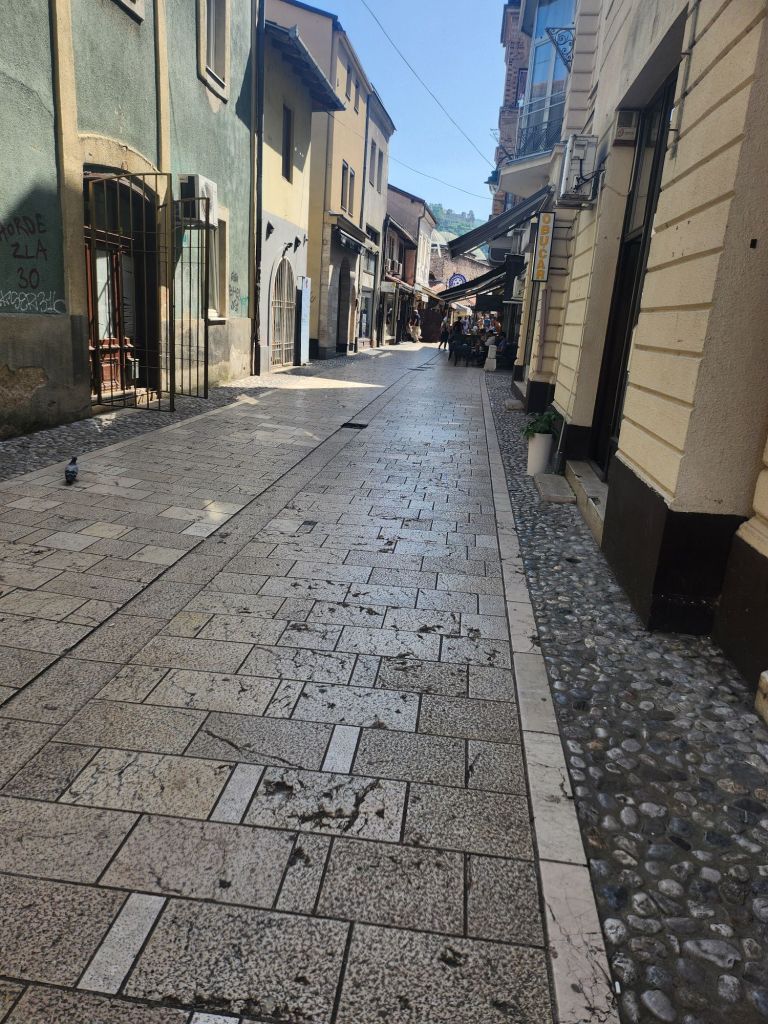
The Sarajevo Old Town is yet another large vibrant pedestrian area, but with a more Oriental, bazaar-like feel than the ones on the western part of my trip– narrower streets, low, cushioned seats at the bars and restaurants, hookah bars, minarets. The architecture is a jumble of Ottoman, Austrian, socialist, and post-1992 bombing buildings.

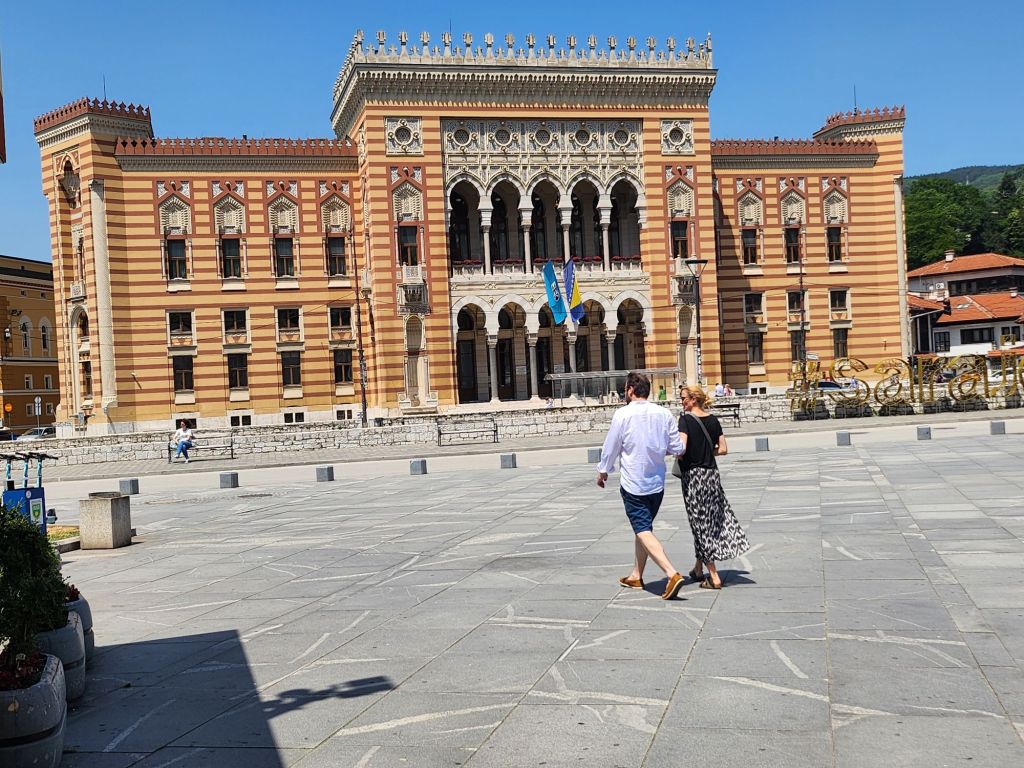
The town hall built by the Austrians in a Moorish style in an attempt to placate the Muslim population.
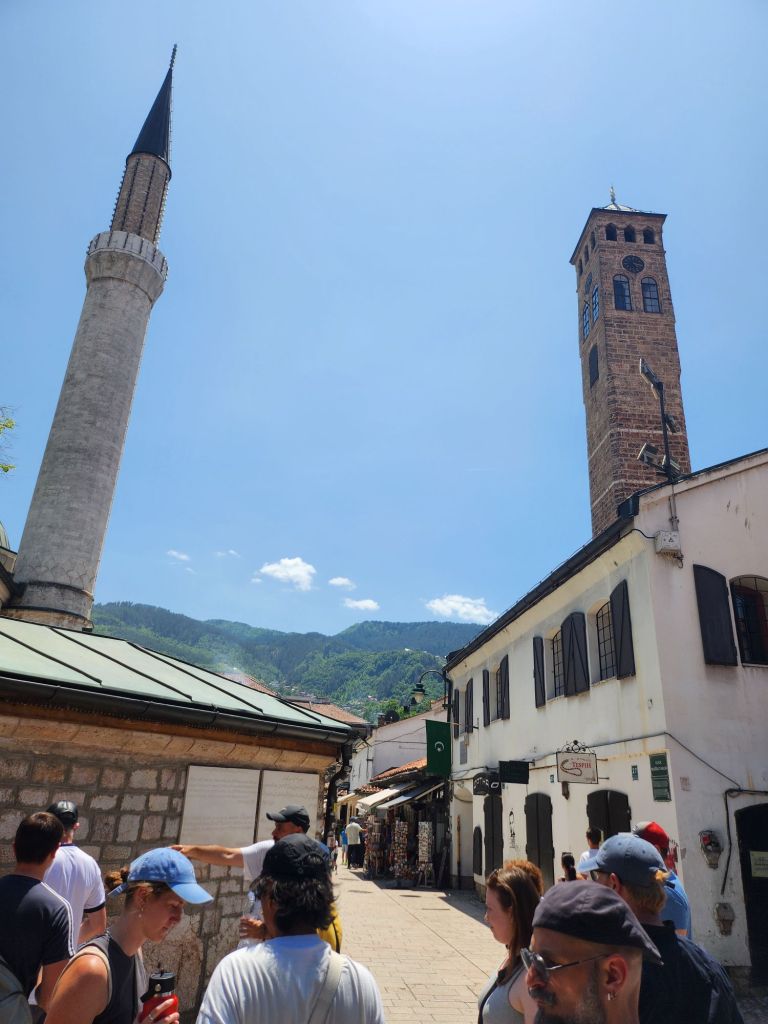
A minaret and clock tower. The clock always shows 12:00 as sundown (if sundown is in an hour it shows 11:00) so it has to be reset every day.
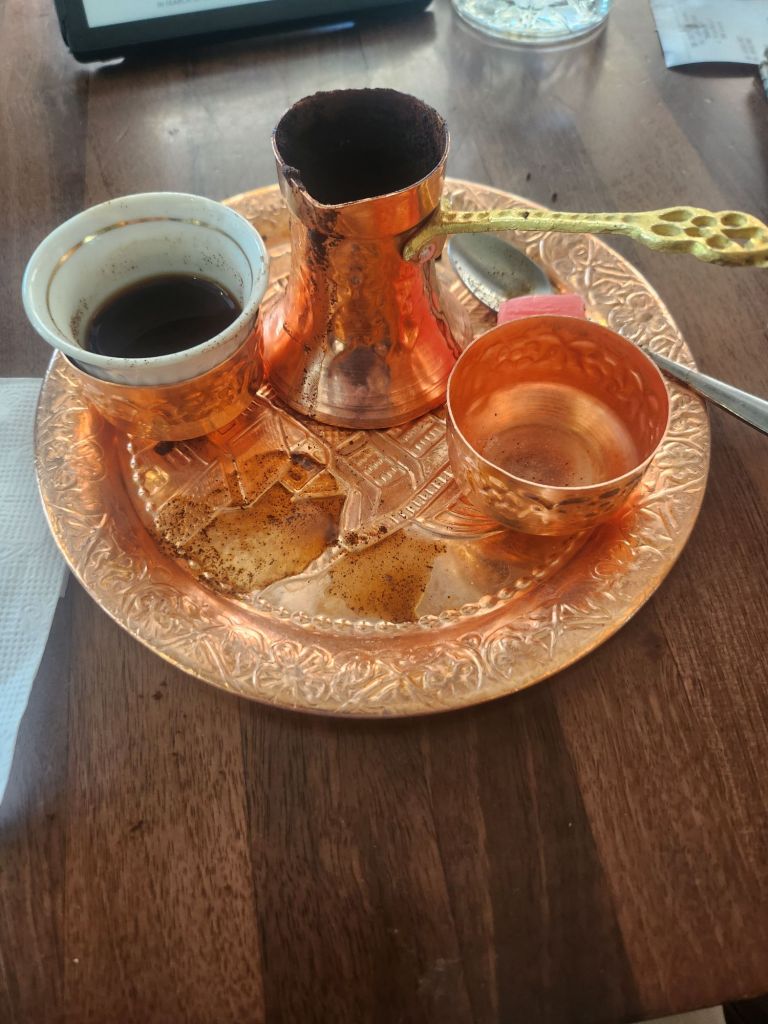
The Bosnian coffee I got one morning; very strong like Turkish coffee, but the sugar came on the side (in the brass dish).
Neno was 8 in 1992 and so endured the siege of Sarajevo that lasted more than four years. He was surprisingly lacking in bitterness. I learned more at the Museum of Crimes Against Humanity, and at the Siege of Sarajevo museum. The problem with the Serb desire to live in a Serbian state was that in 1992 the Serbian, Croatian and Muslim populations all lived all over Bosnia in varying concentrations. There were atrocities on all sides – Serb, Bosnian, Croatian – but by far the greatest and gravest war crimes were committed by the Serbs. Among the war crimes was the indiscriminate shelling and sniping of Sarajevo during a siege that lasted almost four years, longer than the siege of Leningrad. The museums covered all this in wrenching detail, with placards in English as well as Bosnian, with testimony from survivors describing the individual and collective murders. The Bosniaks hoped for Western intervention, but they got only humanitarian aid until the degree of Serb atrocities shamed Western leaders (including Bill Clinton) into military intervention. The eventual negogiated solution rejected the Serb desire for annexation by Serbia, but granted them a large degree of autonomy in areas where they predominated. (The museums covered the war from a Bosniak point of view, but that version did not differ much from Wikipedia.) Bosnia now is much more segregated than it was before the wars. Sarajevo is 80% Muslim (though only maybe 10% of the women wore headscarves, and none that I saw wore any more coverage than that).
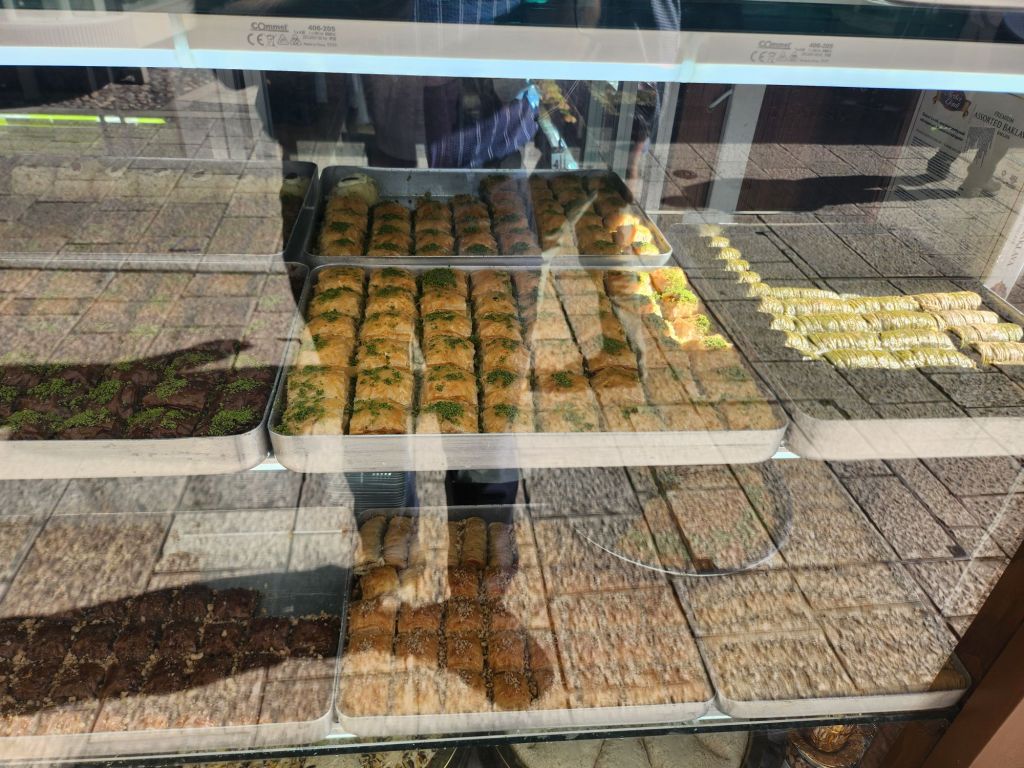
To avoid ending on that depressing note, here’s some baclava, including an image of me.

 helperblog
Leave a reply to Anonymous Cancel reply